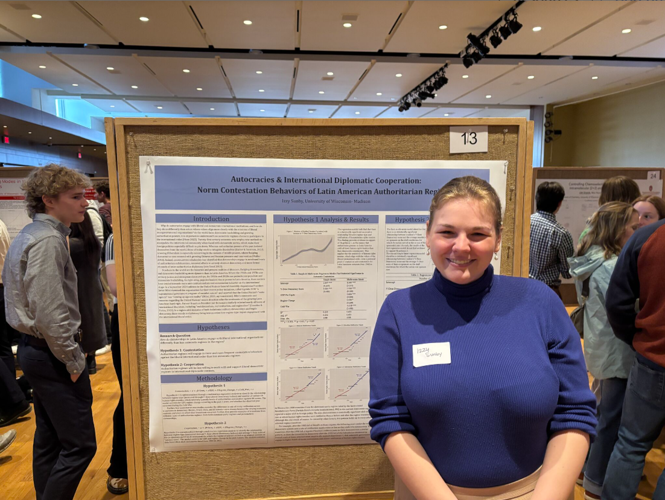


Izzy Sunby has had the opportunity to professionally present the research she conducted at UW–Madison.
Often, when Americans think about politics, their mind goes to Democrats, Republicans and the state of affairs in the United States. For Izzy Sunby, it’s different. Her mind turns to democracies, autocracies and how international governments develop foreign policy. As a senior at UW–Madison majoring in political science and Spanish, her research has taken her on thought journeys about Latin America, China and the United Nations. This work inspired her thesis as she prepared for graduate school — she was just accepted into a PhD program at Harvard University — while also opening her eyes to some unexpected realities of global affairs.
What is your research about?
My research is on comparative authoritarianism and authoritarian foreign policy in international organizations and the international economy. More generally, it’s about how authoritarian regimes decide to engage with other countries and the elements of their domestic politics that make that advantageous for them. The first project that I did through my sophomore research fellowship was on how Latin American autocracies collaborate with each other in the United Nations and how they, through the ratification of United Nations (UN) treaties, contest, disagree and show their disagreement with liberal norms. Now, my current senior honors thesis project is on how China uses their foreign aid projects to enshrine stability in autocracies that receive their aid but that don’t help stability in democracies.
People are also reading…
Why did you choose your topics?
The first topic stemmed from my involvement in Model UN. I was doing a lot of engagement in these diplomatic discussions. And you can see, even in simulated UN discussions, that people who are not representing democracies clearly have a different method about how they are going about speaking about their politics and their level of domestic constraints. That made me think, how are people in the real UN representing these autocracies collaborating with one another if they’re not acting like democracies? And then my current project stemmed from my growing interest in China that developed through a Chinese politics class that was part of my Chinese certificate.
What have you learned?
Contrary to popular belief, China isn’t this rogue actor that is giving malicious aid to different countries to try to make them autocratize. That’s not like what I’m finding at all. Through reading, I’ve learned about the way that China provides aid to different countries. I’ve also learned a ton about Latin American domestic politics and how that influences the way that they trade with other countries and the way that they receive aid.
How did you get involved in this kind of research?
I started in a research position my sophomore year. I just reached out to a bunch of professors in the political science department to see if anyone needed a research assistant. First, I did some data management wrangling for Professor Tana Johnson in the La Follette School of Public Affairs. And then after a year as a research assistant with her, I completed a sophomore research fellowship, which is a project that ended up being my writing sample for graduate school. And then that made me really excited about conducting my own research. And from that, I applied for a Hilldale Undergraduate/Faculty Research Fellowship for my senior thesis in political science.
How has doing undergraduate research impacted your college experience?
It’s changed everything about my college experience. Being able to do research and get that experience set me up for grad school really well, because it would be much more intimidating to go into a research grad program without this background. I also think it has given me such a great sense of community. In the political science department, we have a fantastic group of us who are writing theses in political science, and there’s a seminar that we have every Monday. And so, I have made great friends and received helpful feedback from many of my peers there. It also just deepens faculty contact, because it’s one thing to go to office hours and chat about course material. But to come in with your own questions and be discussing, “How do we go about this? How does this relate to the other questions that are being asked? And how do I market this in a way that that matters really?” It helps you develop faculty connections, and I’ll have those connections for the rest of my life.
—
About the Researcher
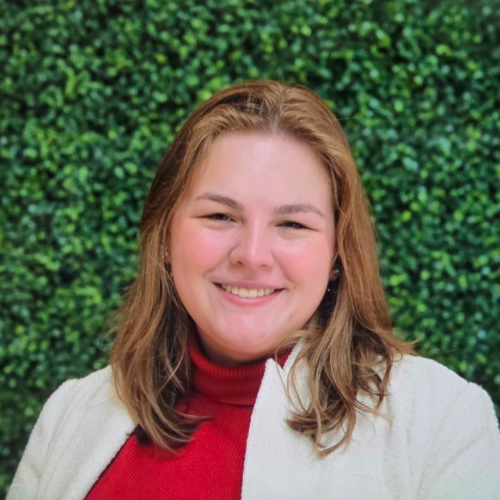
Izzy Sunby is a senior at the University of Wisconsin–Madison studying political science and Spanish with certificates in Chinese professional communication and statistics. After graduation, she will go to Harvard University to pursue a PhD in the Department of Government.