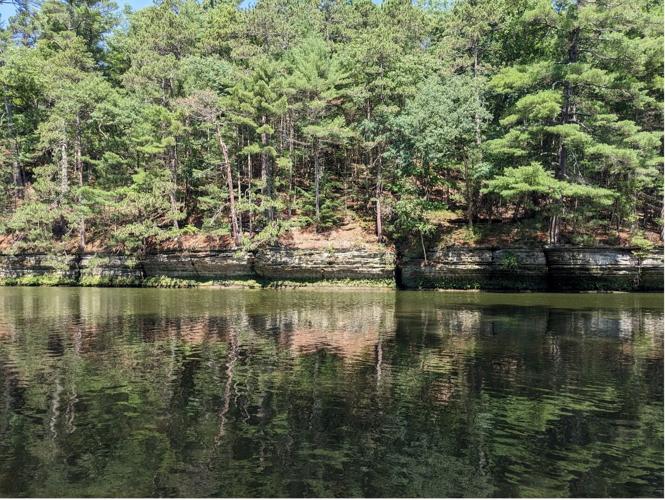


Researchers study the surface water and groundwater exchange of phosphorus on the Wisconsin River.
The straight-six Ford engine roared to life. In the confined space of the pump house, the noise was deafening as we watched the water pump kick on. This pump was pulling groundwater up to the surface, headed for filtration and iron treatment before entering the municipal distribution lines in Footville, Wisconsin. Normally, the Ford motor is quiet — it’s only used as a backup generator when the pump house loses power. We had never come across this type of “hot rod” backup generator, but it illustrates both local ingenuity and how vital groundwater access is as a source of drinking water for the residents. My research focuses on the array of challenges facing groundwater quality and quantity across Wisconsin.
The reason my students and project collaborators were standing in a pump house in Footville is because while the water is treated for excessive iron and manganese, it isn’t treated for excessive radium. Radium is one of several harmful geogenic contaminants often found in groundwater throughout Wisconsin. Geogenic contaminants occur naturally in the rocks beneath our feet, and when we pump out groundwater, these contaminants may be present in the water. The research project that took us to Footville is focused on understanding how radium is mobilized in groundwater so that we can better understand how to construct wells and manage aquifers to minimize the expensive treatment that is otherwise necessary to provide safe drinking water.
People are also reading…
The vast majority of people in Wisconsin rely on groundwater for drinking water, and Footville is by no means alone when it comes to groundwater quality issues. In addition to geogenic contaminants, my group studies the movement and fate of anthropogenic contaminants introduced by human activity, including PFAS, nitrate and phosphorus. For example, a graduate student in my group is building a model to understand future risks of PFAS contamination to new municipal wells being installed on French Island in the Mississippi River near La Crosse. Another graduate student is measuring how phosphorous in the Wisconsin River is stored in riverbank sediments to understand how these release mechanisms may contribute to algal blooms.

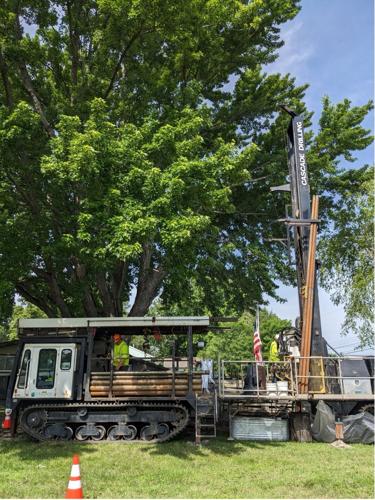
Workers drill a PFAS monitoring well in Town of Campbell.
Water quality, however, is not the only concern impacting drinking water availability. As Wisconsinites, we are accustomed to feeling that water is an abundant resource because lakes and rivers are everywhere that we look. Below the surface, however, the story can be quite different. In many areas of northern and north-central Wisconsin, much of the groundwater is present in aquifers made up of the thin layers of sediments deposited during the last ice age. When this water gets contaminated — or when those sediments are too clay-rich to yield sufficient water — the wells are often drilled and hydraulically fractured deep into the crystalline rock below. Even then, wells may not provide enough water and can run dry for extended periods of time. A new project near Marshfield is working with dairy operations and other industrial users whose wells are not supplying the necessary volumes to sustain operations. With improved understanding of how water moves through these complex aquifer systems, we aim to provide drillers, operators and regulators with new approaches to optimize water use in areas of the state where groundwater is scarce.
Groundwater is recharged into the aquifers beneath our feet through precipitation, snowmelt and surface water exchange. These processes are often slow, occurring over years, centuries and sometimes even millennia. As a result, the decisions that we make today about land use, waste management and groundwater withdraws will impact groundwater resources for years to come. As a sixth-generation Wisconsinite and faculty member at the University of Wisconsin–Madison, I get to study these groundwater systems while training the future scientists and regulators who will manage them, helping ensure our long-term access to clean, dependable groundwater across the state.
—

About the Researcher
Chris Zahasky is an associate professor for UW–Madison’s Department of Geoscience. His research focuses on using experimental, analytical and numerical methods to improve understanding of fundamental physics and mechanisms of fluid, gas and solute transport in complex aquifer systems.