


UW–Madison’s College of Letters & Science is launching a new Center for Humanistic Inquiry into AI and Uncertainty.
Artificial intelligence is transforming our lives at an unprecedented pace, raising urgent questions about fairness and justice, knowledge and power, creativity and trust. How can we build and deploy AI systems that treat people and communities fairly? Who should decide when important decisions are handed over to algorithms? Are there areas of human life that should never be automated? Can AI reduce problems like misinformation and political polarization rather than worsen them? And when AI generates art, music, film and writing resembling the products of human creativity, how should we understand these outputs and the value we assign them?
The fundamental question is simple but profound: How do we live well in an age when machines increasingly mimic human reasoning, judgment and creativity?
Launched in January 2026 within the College of Letters & Science, the Center for Humanistic Inquiry into AI and Uncertainty confronts these questions head-on. The Center draws on the humanities to examine the meaning and ethics of AI technologies and their impact on society and culture. Its goal is to help shape a more human-centered future — one in which human values guide the development, deployment and use of AI.
People are also reading…
A key theme across the Center’s work is uncertainty. While uncertainty is often treated as a technical problem — something to be reduced through better data or more powerful algorithms — the Center approaches it differently. In this context, uncertainty refers to the many ambiguities surrounding AI technologies and their evolving role in human life.
AI systems may be marketed as tools that remove doubt by predicting outcomes and automating complex tasks. Yet they also introduce new uncertainties. Questions arise about the data used to train AI models, the reliability of the outputs they generate and the accountability of those who design and use them.
For example, deepfake videos blur the line between real and fabricated images, making it harder to trust what we see on our screens. Similarly, the growing use of decision-making algorithms in fields such as healthcare and finance raises concerns about biases embedded in the often opaque data sets used to train them. These uncertainties are not merely “bugs” that better programming can fix. They are fundamentally ethical and social challenges that shape how we experience technology and live our lives.
This is where the humanities play a vital role. Fields like philosophy, history, communication arts and literature are uniquely equipped to examine ambiguity, understand social and cultural change, and address deep questions about human values, agency and responsibility. As AI reshapes our institutions and daily practices, human-centered inquiry becomes all the more essential for understanding its impact and guiding its future.
The Center brings together leading researchers who study the ethical, political, social and cultural implications of AI. Its steering committee includes faculty from philosophy, the information school, history and communication arts. Each year, the Center also hosts a new cohort of fellows whose research introduces fresh ideas and questions about the role and future of AI in human life.
Every year, the Center produces a white paper examining current and emerging developments at the intersection of AI, uncertainty and society. Drawing on research from fellows and faculty, the paper identifies pressing ethical and societal challenges and proposes frameworks for using AI in fair and responsible ways.
In keeping with the Wisconsin Idea, the Center’s mission extends beyond the bounds of campus. It hosts public forums, workshops and community discussions, bringing together scholars, policymakers, industry practitioners and members of the public from across Wisconsin. This approach ensures that debates about AI include a wide range of voices and perspectives.
By placing human values and ethical reflection at the center of AI research, the Center ultimately asks not only what AI can do, but what it should do. In a world increasingly shaped by algorithms, wisdom, responsibility and respect for human dignity have never been more essential.
—
About the Researcher
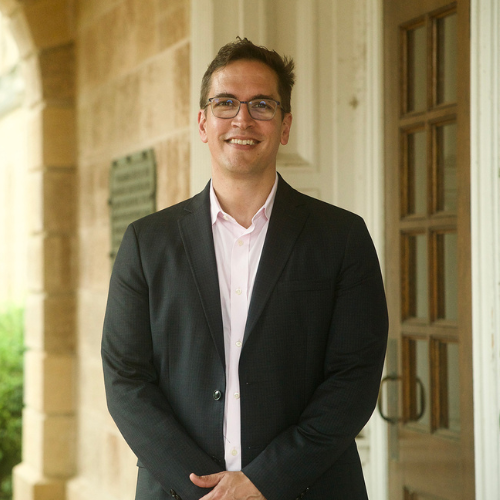
Grant Nelsestuen is the associate dean for arts and humanities at UW–Madison’s College of Letters & Science and a professor of classics. His research focuses on Roman political thought and cultural history, late Hellenistic intellectual history and the literature of the late republic and early empire.