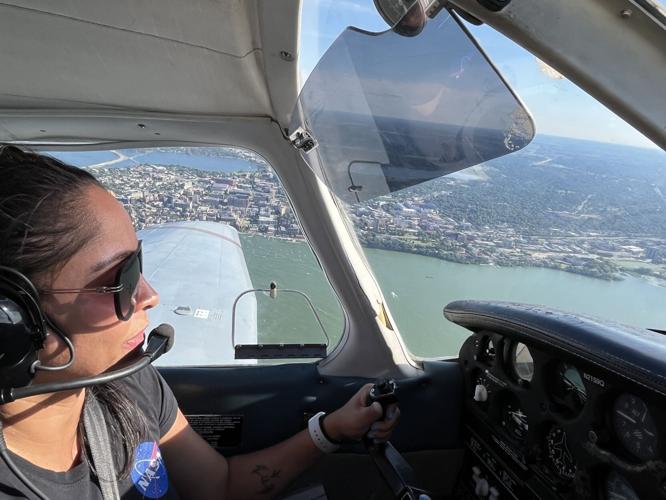


Mayra I. Oyola, who is training to be a pilot, flies over the Madison isthmus.
With a research specialty in severe weather and aviation hazards, it might surprise you to know that I didn’t step onto my first airplane until I was 20 years old. Growing up in rural Puerto Rico, airplanes represented movement and possibility, but they belonged to a world that seemed far removed from my own. Becoming a pilot or a scientist felt distant — even unrealistic. That distance is not so different from what many young people in rural Wisconsin experience. In communities rooted in land and resilience, opportunity can feel just out of reach, and education becomes the bridge between circumstance and possibility. It was for me. Today my research investigates the changing trends in aircraft turbulence with the aim of making flights safer. Plus, I’m in training to become a pilot myself.
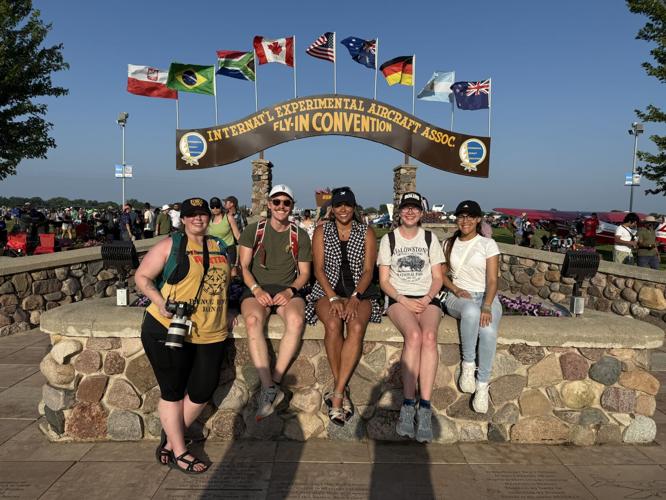
After becoming a first-generation college graduate, I went to work as a scientist for the Department of Defense and then NASA, before moving to Wisconsin for a professor job at UW–Madison. I knew of the University’s strong research reputation and vibrant community, but what came as a pleasant surprise was the discovery that Wisconsin has one of the most aviation-centered communities in the world. In this state, flight is woven into history, economy and identity. Billy Mitchell, who played an instrumental role in the creation of the U.S. Air Force, made the argument that air power would shape the future while standing on Milwaukee soil. Truax Field in Madison is the base where pilots trained for World War II. That story did not fade, it evolved. Today more than 100 public-use airports serve communities across the state, including rural airports carrying medical flights and agricultural aircraft. Dane County Regional Airport connects the capital to major cities, and each summer in Oshkosh, half a million visitors and thousands of aircrafts from around the world descend on Wittman Regional Airport, making it the busiest airport in the world for one week. Yes, here in our backyard.
People are also reading…
Witnessing that was not abstract to me. The child who once watched airplanes from a distance now lives in a state where flight defines community. My research exists inside that context.

Mayra I. Oyola (center) takes student researchers to the International Experimental Aircraft Association Fly-In Convention in Oshkosh
I study the invisible structure of the air that aircraft move through. Most people think of turbulence as random shaking, but it’s not random. High above us, powerful rivers of fast-moving air called jet streams move across the country. Along the edges of those rivers, winds change speed or direction abruptly, and those sudden shifts are called wind shear. When aircraft cross those boundaries, the air can become unstable, sometimes violently so. When a commercial flight encounters severe turbulence and makes national headlines, our field works to understand what the atmosphere was doing at that moment and how we can prevent that from happening. Where was the jet stream positioned? How sharp were the wind changes? Was there an unstable layer of air that allowed energy to cascade downward? These are not abstract questions. They determine whether flights remain safe.
Closer to the ground, winds matter just as much. When wind blows strongly across a runway instead of along it, pilots must compensate constantly to stay aligned. Those crosswinds can turn an ordinary landing into a challenging one, especially for smaller aircraft. In my lab, students analyze how often those conditions occur at regional airports like Madison and how they vary seasonally. They learn that atmospheric science is not just theory, it directly impacts safety at the airports that serve this state.
As a student pilot myself, I feel this every time I fly. Every takeoff depends on wind, and every landing depends on stability. What looks like calm air from the ground often contains structure that only instruments and science reveals. For me, airplanes and atmospheric science are inseparable. The sky that once symbolized distant possibility now represents responsibility. In Wisconsin, that responsibility is shared across generations, from the state’s aviation pioneers to the students in my lab and to the child standing along the runway fence in Oshkosh, looking up.
—

About the Researcher
Mayra I. Oyola is an assistant professor and the Ned P. Smith Distinguished Chair of Meteorology, Atmospheric and Oceanic Sciences at the University of Wisconsin–Madison. A former Department of Defense and NASA scientist, she studies aerosols and weather processes using atmospheric modeling and satellite remote sensing. She also leads research on aviation weather, turbulence and flight safety.