


Incarceration rates and racial disparities among incarcerated people are falling in the United States and have been for nearly 20 years. It is the first sustained decrease in a century and a reversal following a steep increase that began in the late 1970s and continued through the 1990s.
A new analysis of data from law enforcement and prison admissions highlights the extent of declines and shows that the reasons prison populations are shrinking differ from the reasons incarceration grew.
The number of people imprisoned in the United States grew from about 300,000 at the end of the 1970s to a peak of just over 1.5 million in 2009, a boom largely driven by more severe police enforcement and court penalties.
But the rate that people are being sent to prison has fallen by one-third since 2007, and in 2019 dipped as low as it has been since 1988. As a result, the imprisonment rate in state prisons, the country’s most populous prison jurisdiction, has declined 20% since 2007. These declines were substantially larger for Black Americans than white Americans.
People are also reading…
For violent crimes and property crimes, the decline in people sentenced to prison has been driven almost entirely by a decrease in the offenses themselves, not changes in the criminal justice system, according to a new study by Michael Light of the University of Wisconsin–Madison and Jason Robey of the University of Iowa.
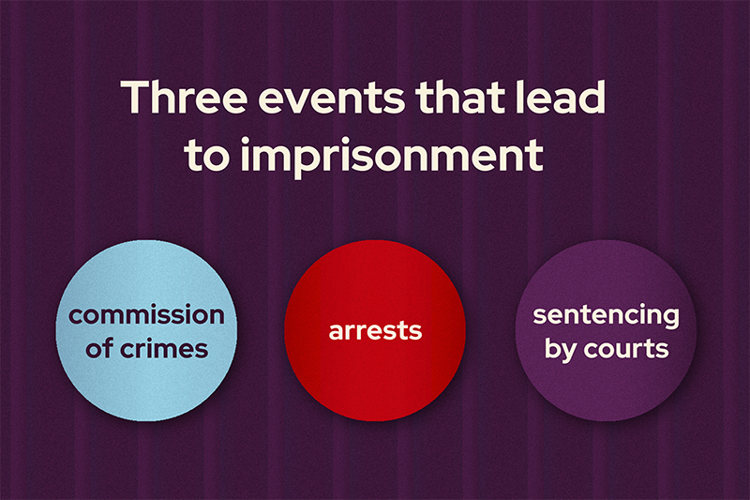
The researchers looked at data over time for three events that pave a path to imprisonment: the commission of crimes, arrests by police, and sentencing by courts.
For violent crimes (including murder, assault and robbery) and property crimes (like burglary, car theft and larceny), the researchers compiled data from crime reports shared by local law enforcement with the FBI and also from annual surveys that ask Americans whether they have been the victim of a crime.
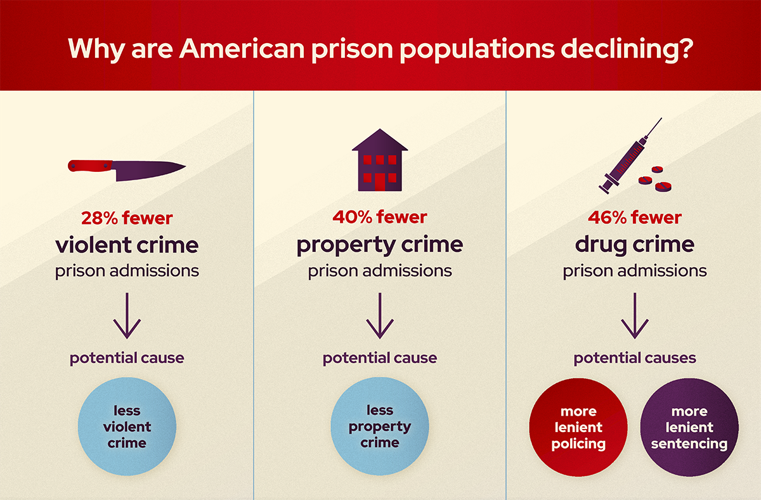
The trend is stark. In 2005, there were 4,590 reported property crimes per 100,000 people in the United States. By 2019, that had fallen to 2,730 crimes, a 41% decrease. From 2000 to 2019, the violent crime rate declined by 32% — an even more consequential difference for prison populations, since the majority of people in state prisons (about 63%) have been convicted of violent crimes. For Black Americans, the prison admission rate for violent offenses has declined even more sharply, by 43%, and was driven entirely by a 47% reduction in violent crime rates.
“The decrease in incarceration rates is very obvious for violent and property crime,” says Light, a UW–Madison sociology professor. “The likelihood that an arrest is made following one of these crimes barely changed in 20 years, and the likelihood that an arrest results in a prison sentence actually increased a bit. So, essentially 100% of the decrease in incarceration for violent and property crimes is attributable to fewer of those crimes happening.”
Drug crimes are a different story. According to national surveys, illicit drug use actually increased in the United States during the years of declining incarceration rates, suggesting that drug crime was not dropping like violent and property crime. What has changed is the arrest rate.
“The likelihood that you were arrested for a drug offense has gone down pretty significantly in the United States,” says Robey, an Iowa professor of sociology and criminology who began studying incarceration while working on his doctorate at UW–Madison. “That’s driven mostly by a really large reduction in the probability that Black Americans, in particular, were arrested and put in prison for drug offenses.”
Black people were 46% less likely to be arrested for a drug offense in 2019 than in 2000. And in 2019, they were also 53% less likely to go to prison following a drug arrest than they were in 2000. The combined effect is a 75% decrease in drug-related prison admission for Black people from 2000 to 2019. Arrest and prison admission rates also fell for white people, though the changes were much smaller and prison admissions decreased a more modest 13%.
As a result, the Black-white disparity in prison admissions for drug offenses drastically changed from more than 12 to 1 in 2000 to less than 3 to 1 in 2019.
The particular reasons that drug crime arrests and prison admissions have fallen, while drug use did not, were not clear from the national data the researchers studied, and Light and Robey are studying state-level differences in an effort to better explain the change.
What they do think is clear is that significant decreases in incarceration are not likely the result of high-profile criminal justice reforms.
“A lot of research has shown that the sort of criminal justice reform efforts that have happened in the United States to date have focused on what some people call the ‘nons’ — the non-serious, the non-violent, the non-sexual offenders,” Robey says. “And what we’re seeing is consistent with that, that the system hasn’t changed for the violent and property crimes that send most people to prison.”
If you want to continue reducing the scope of mass incarceration, you kind of have one big lever to pull, and that is reducing violent crime. That may be where we’d like the policy focus to stay.
Michael Light, professor of sociology
The legalization of marijuana also had little influence on national incarceration rates, as marijuana crimes have represented such a small slice of prison admissions — just 3% — and because incarceration had already been trending down for years before Colorado legalized recreational use in 2014.
And, according to the new study, average prison sentences were just as long for most crimes in 2019 as in 2000, meaning prison populations were not shrinking because people sent to prison were leaving sooner.
So, the list of ways to lower incarceration rates even further dwindles to what appears to be working already, according to Light and Robey. Criminologists have shown the effectiveness of many efforts, such as improving policing strategies and supporting the development of non-profit, civic organizations focused on fostering community and reducing violence, that were — not coincidentally — growth areas in American cities from the 1990s to 2010s.
“While there is evidence that other approaches may help, there’s very little evidence that there’s a political appetite for ideas like reducing the punitiveness of sentencing for serious violent crimes,” Light says. “So, if you want to continue reducing the scope of mass incarceration, you kind of have one big lever to pull, and that is reducing violent crime. That may be where we’d like the policy focus to stay.”


