
You know the inconspicuous houseplant in your kitchen window? It has superpowers. It, and nearly all plants, harness the energy in the sun’s golden beams to convert carbon dioxide from the air into usable sugars that power their cellular processes. Essentially, plants use sunlight to eat air.
I still remember sitting in class as an undergraduate and learning about this process. I had heard of photosynthesis before, but never had I really thought about the transformation of inorganic carbon dioxide into sugars as something so completely profound. Each fall I try to convey the importance of this process in my Introductory Biology course. We don’t cover the gory details of the biochemistry — I leave that joy for more advanced classes — but instead focus on the beauty of the cycle of photosynthesis. Nearly all the oxygen in our atmosphere, which we require to survive, is a biproduct of photosynthesis.
People are also reading…

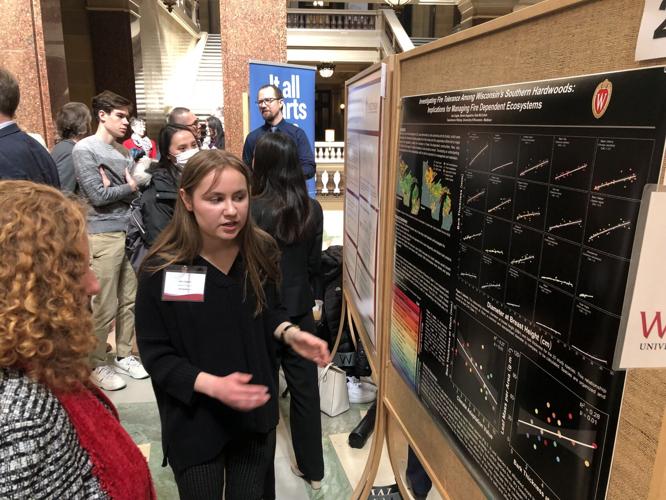
Undergraduate researcher Ava Copple explains her research to Chancellor Jennifer L. Mnookin at the 2023 Research in the Rotunda in the Wisconsin State Capitol.
Plants’ remarkable features don’t stop at photosynthesis, and the research team I lead in UW–Madison’s botany department aims to uncover more by answering a fundamental question: How do organisms that cannot move across a landscape tolerate the various insults the world hurls at them? Animals, in contrast, move into the sun when they are chilly, or the shade if they are hot, or quickly away if they feel threatened. Plants have none of these solutions as options. Instead, their complex physiology responds to each of these threats in often quite subtle ways. The solutions that plants employ differ among species, varying with the climate in which those species evolved.
Our changing climate has made understanding how plants work even more imperative. Globally, photosynthesis removes an enormous amount of carbon dioxide from the atmosphere each year, ebbing the increase of greenhouse gasses in our air from our use of fossil fuels. Much of the work in our research group is focused on understanding how photosynthesis is limited by the stresses in plants’ habitats, for example drought and high or low temperatures. Part of this involves quantifying how much plants can shift their body plan and function in response to stresses.
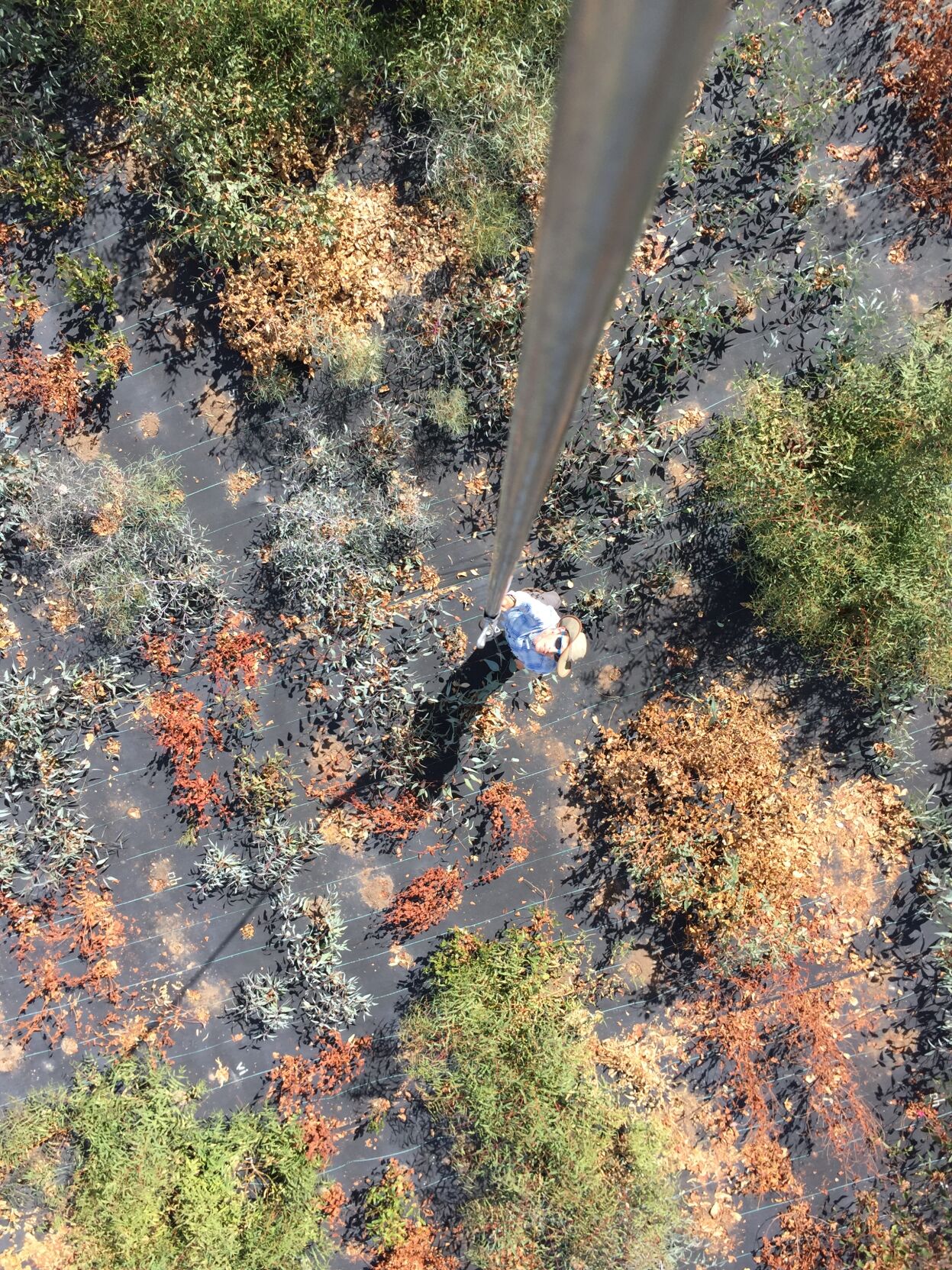
Scientist Duncan Smith uses a very long “selfie stick” to capture the condition of young eucalyptus trees growing in one of the common gardens in Australia.
One recent collaboration with UW–Madison colleagues Tom Givnish – the Henry Allan Gleason Professor of Botany and Environmental Studies – and Scientist Duncan Smith explored these ideas in 10 species of eucalyptus trees that naturally grow in areas that differ in the amount of rainfall they receive annually. Our study species ranged from trees that reach 100 meters tall growing in the moist mountains northwest of Melbourne, Australia to stunted trees that top out at five meters and survive the harsh aridity of Australia’s Outback. We grew individuals from each of these 10 species in each of four sites along this gradient in water availability — from the wet mountain sides in the southwest to the dry interior of Victoria, Australia – and measured various traits ranging from their photosynthetic rates, to how much water stress they experienced, to their sizes. We learned that species can adjust several traits that improve their ability to grow in either wetter or drier conditions than those in which they evolved but are unable to adjust enough to grow as well as in their home conditions.
These results provide useful insight into the limits on species’ ability to adjust to the new conditions created by our changing climate. As part of this project, we also offered a course in which we took 14 UW–Madison undergraduate and graduate students on a 16-day trip to Victoria, Australia, where the students learned about the ecology and evolution of Australian plants and animals and conducted independent research projects that they had developed during our preparative seminar.
Our lab group has worked on several other projects to understand how plants respond to their environment. We have studied how cycads (an ancient group of seed plants who outlived the dinosaurs) evolved to tolerate drought stress, the traits that allow Wisconsin’s trees and shrubs to live in their habitats, how species differ in their ability to take up water through their leaves, what limits the growth of some of the world’s tallest trees, and how species that have evolved with regular fires both survive fires but also facilitate fires. Our lab group prides ourselves on involving undergraduates in meaningful research experiences, and we have worked with students who have gone on to graduate school, industry and government agencies, but also medical, dental and law school. Learning about the remarkable adaptations of plants specifically, but also how to ask scientific questions generally, is enriching, rewarding, and fun!
--

About the Author
Kate McCulloh is an associate professor in UW–Madison’s Department of Botany and the inaugural Rebecca Blank Professor. Her research explores how plants tolerate environmental stresses such as drought. She has studied plants in many habitats, including temperate forests, temperate and tropical rainforests, grasslands and savannas.