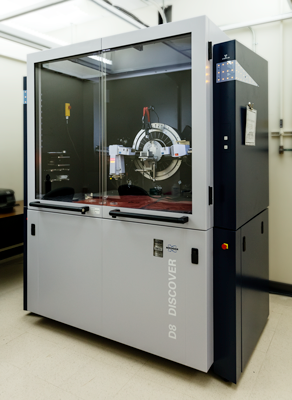
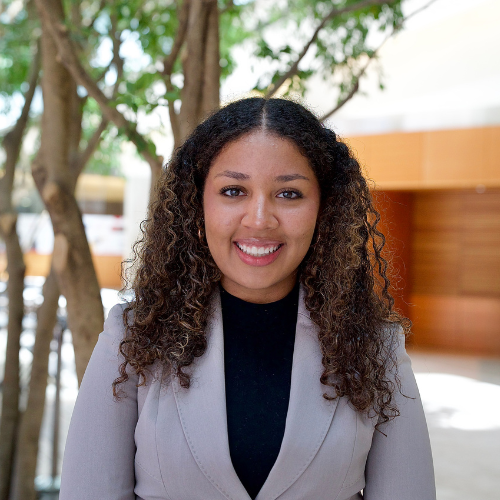
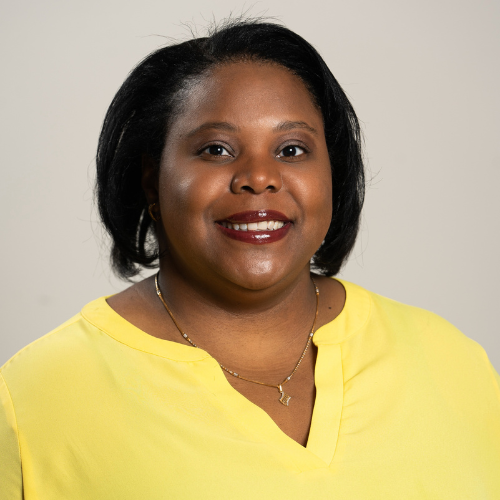
Ahmia Williams-Walsh in the lab doing data analysis of the XRD machine spectra X-ray refraction machine.
As soon as Ahmia Williams-Walsh came to campus from Menasha, she hit the ground running looking for research opportunities. Now, as a junior majoring in chemistry, biochemistry and sociology, she’s involved in a significant sustainability effort by the Department of Chemistry’s Hermans Research Group to find practical ways to decrease the amount of carbon emissions it takes to produce plastics
Why did you choose UW–Madison?
You really can’t beat the research programs here. One of the things that was important for me was to feel confident I would find good undergraduate research opportunities. I was able to find that here beginning my freshman year.
What’s your research about?
We focus on the polypropylene reactions, the synthesis of plastics and polymers in industry, which creates a lot of carbon and pollutes the environment. The way that we are trying to negate that is by creating a catalyst that would lower the amount of energy needed and lessen the pollutants.
X-ray diffraction machine
Ilia Guzei
What does it take to create a catalyst with this kind of capability?
We do it in a really fun way — it’s called impregnation — it means that we have an alumina base or an element base and we add other elements to it and then mix it up until it looks good. And then we put that in the oven to heat up and get the water off it, because if there’s water, it won’t react as well. After that, we do a few tests on the synthesized catalyst. This is where I step in. I do some X-ray diffraction, which is an analytical technique where you put the catalyst in this really big machine and it shoots X-rays at it, and the angles that it diffracts at will tell you how the catalyst is loaded. I specifically look for any migration of elements — changes or things that we don’t want to see. I’m looking to make sure that everything looks normal. After that, I go and do other analytical techniques to test and make sure that the catalysts can hold up in the reactor. And then after that, I assist in running the reactor, and we put it under conditions that industry would use and make sure that it will create what we want to create and that it is lowering the energy threshold and that it isn’t giving off as much or more CO2 than what industry would do.
What’s the goal for this research project?
We’re testing really stable catalysts to see what elements we can add to lessen the impact on the environment in the production of plastic products.
The reactor used to test the synthesized catalyst at high temperatures and designed chemical environments.
If this research is fully realized, what would the impact be?
Industry cares about one thing, and that’s the bottom line. We recognize that in order to help the environment we need to work with that, otherwise we can’t make big changes. By implementing a catalyst into industry and lessening the amount of energy that’s needed for these really big reactions, not only are we going to be able to push less energy into the reaction — and that’s in and of itself more sustainable — but there’s less CO2 emissions.
How has being able to do research on campus affected your college experience?
I don’t think I’ve ever done something that’s helped me gain as much confidence as research. Being able to go into the lab, put on my lab coat and my goggles, be there, do actual science and have it work out has to be one of the most amazing feelings I’ve ever felt in my entire life.
--
About the Researcher
Ahmia Williams-Walsh is a third-year chemistry, biochemistry and sociology major hoping to continue her education in medicine after receiving her degree. She is an undergraduate researcher in the Hermans Research Group focusing on heterogeneous catalysis and sustainability. Outside of schoolwork and research, she is also an L&S Dean’s Ambassador, peer mentor, medical program assistant for Mendota Mental Health Institute and a Mercile J. Lee scholar.
This content was produced by UW-Madison’s College of Letters & Science. The news and editorial departments of the Wisconsin State Journal had no role in its creation or display. For more information, contact events@madison.com
Making sense of mindless scrolling
Gráinne McDonagh is a fourth-year undergraduate student, but she’s already worked on a half-dozen research projects at UW–Madison. In 2020, she started as an Undergraduate Research Scholar (URS) and has since worked her way up in the program to become a fellow who mentors peers on their research pursuits. Her research as part of the Social Media & Adolescent Health Research Team (SMAHRT) tackles trends on TikTok and conversations around social media and depression.
Gráinne McDonagh shared her research at UW–Madison’s Undergraduate Symposium
You got to choose your first research project. How did you decide what to study?
It was October of 2020, and at that time, I had been spending a lot of time scrolling online. I ended up choosing to look at body positivity content on TikTok in relation to the COVID-19 pandemic. So, it was really taking this mundane thing — something that I saw in my everyday life — and making a research project out of it and trying to understand why this became so prevalent during the pandemic.
What was the study about?
I hypothesized that body positivity content was increasing during the COVID-19 pandemic and that engagement with the content was also increasing. It ended up being true. Within the three months that we conducted this study, it increased by about 4.4 billion views. It was also interesting to see whether or not the body positivity content mentioned COVID-19 and directly called it out by name. When they did mention COVID-19, we noticed increased interaction with the content. We were considering the way that it’s reflective of what’s going on in the outside world — people’s bodies changing during a time of social isolation.
Why is it important to research trends on social media?
Social media studies in general, and understanding better how social media affects individuals’ mental health, is such an important thing that is emerging. Sometimes it’s easy to forget, when we’re scrolling daily, that social media really isn’t that old. A lot of these studies that are being conducted are noble studies — they’re the first of their kind. We’re still having to work out those kinks. But I think that the broader implication for the entire world is better understanding the impact that the media we’re consuming has on us. Also, it’s a demonstration of what we are consuming. Seeing how many views increased is something that we can look back on in research studies and remember what was happening at that time in the world.
What research have you been working on more recently?
We did a secondary analysis that came from a larger study, which was about understanding news articles about teens, social media and depression. We chose to explore gender a little bit further. This one was talking about social media and depression because that topic was coming up so often — it seemed to be a fear-mongering usage — and we were trying to understand. We took a journalistic approach, and we were looking at news articles that were being shared at national and local levels to see the ways in which authors and journalists were writing about social media and depression and seeing how it may have a broader implication for the way that people are understanding social media.
Gráinne McDonagh shared her research at the Pediatric Academic Societies 2022 Conference in Denver.
What did you learn?
We were seeing this relation between social media and depression with females. But that led to more questions. And part of that has been asking, who are they including for their sample when they’re doing this research? Sometimes we’ve seen that a lot of the literature reviews only included young women, and so in that case, if we had a fuller picture, maybe we wouldn’t have come to that idea.
How has doing this kind of research changed how you think about social media?
I think to really understand what we’re consuming, we have to look with more of a critical lens and consider the source and look at things more deeply. That’s an idea that is instilled with us at UW–Madison: Don’t take everything for what meets the eye, but instead really think about things and synthesize them.
--
About the Researcher
Gráinne McDonagh is a senior undergraduate student pursuing a major in Health Promotion and Health Equity as well as earning a certificate in Gender & Women’s Studies. During her time as an Undergraduate Research Scholar (URS), she worked as an undergraduate research and promotions intern for the Social Media & Adolescent Health Research Team. She has presented her findings at five conferences and symposiums nationally and internationally.
This content was produced by UW-Madison’s College of Letters & Science. The news and editorial departments of the Wisconsin State Journal had no role in its creation or display. For more information, contact events@madison.com
The logistics of learning language
Majoring in psychology runs in the family for Howard Owens, a sophomore at UW–Madison. Following in the footsteps of both his parents, he came to campus with a plan. His work in the Department of Psychology caught the attention of recruiters for the Letters and Science Summer of Excellence in Research (LASER) program. He applied and was accepted, which led to him working in the Infant Learning Lab where he studies how toddlers learn language.
Howard Owens did research in the Infant Learning Lab as part of the Letters and Science Summer of Excellence in Research (LASER) program.
Why did you choose to study psychology?
Both of my parents have a degree in psychology. I was drawn to the field, because I really enjoy the topics behind people’s behaviors, the development aspects, and learning about how our brains are influenced by environmental factors.
And why did you pick UW–Madison?
When I was applying, I was looking at the top psychology programs in the country, and UW has a top-10 program. That was one of the main reasons, but also there were all these opportunities to do research as an undergraduate student.
What’s your research about?
I’ve been studying statistical learning, which is the ability that allows us humans to make predictions based on previous things from our environment, and this is how we learn language. As a toddler, you have the ability to pick up information from your environment, and in doing that you’re learning language patterns.
How do you research the learning of language patterns?
We have toddlers from ages 22 to 26 months old sit in a booth and they watch a video. What these videos are testing — and what this project is trying to answer — is this question: Can toddlers make predictions based on statistical structures or word sequences? In order to test this, we had to make creative video trials. These video trials would have two blank screens, and then an image would appear, and this image would be paired with a non-familiar noun and then be followed by a familiar noun. We’re trying to see if toddlers pick up that the non-familiar noun equals the familiar noun. To determine this, we use eye tracking, because these toddlers are at a point where they’re starting to produce language, but they’re not efficient enough to tell us exactly what they’re producing. So, we track their eyes to see if they’re picking up the nouns. What we’ve seen so far, in the older toddlers, is that they are doing it.
What is the hypothesis for the study?
The hope is that the toddlers are able to do this task, and they are able to make predictions based on word sequences. Past literature has supported this in the field, but we’re trying to go more in depth.
How could the findings from this research help people?
One thing with the LASER program is that we are constantly thinking about The Wisconsin Idea — that what we learn in the classroom, shouldn’t just stay in the classroom but go beyond to help people in society. And we’re trying to use the research and apply it so that people in society or other programs can learn how to make language learning more efficient.
--
About the Researcher
Howard Owens is a sophomore majoring in psychology at UW–Madison. During his time in the Letters and Science Summer of Excellence in Research (LASER) program, he started doing research at the Infant Learning Lab, studying how toddlers learn language. After the program ended, he was invited back to continue his work as a research assistant.
This content was produced by UW-Madison’s College of Letters & Science. The news and editorial departments of the Wisconsin State Journal had no role in its creation or display. For more information, contact events@madison.com
The digital town hall
The 2008 U.S. presidential election was in full swing at the start of my junior year of college. As a political science major, I considered it important to be an informed voter, especially since this was my first time voting in a presidential election. Civic technologies played a huge role in facilitating political discussions that election cycle, bringing the crowds from every part of the country to a digital town hall. Through platforms like Facebook, YouTube and Twitter I was amazed at how groups of people across the nation came together to engage in meaningful political discussion. It was during this time that I developed a passion for building and understanding how people — “the crowd” — could engage in meaningful action facilitated by well-designed digital technologies.
Since then, technology has grown at a frantic pace. Large language models can now synthesize information at an unprecedented scale and autonomous vehicles can navigate without human intervention. This has caused a dramatic shift in how people collaborate, communicate and relate to one another. We know that many of the challenges we face today involve computers, but often we forget about the social — or the socio-technical — dynamics. This inspired me to explore how the development of technology can be augmented and enhanced to support insights from a diverse crowd.
Propelled by my interest in civic technology as an undergraduate student, my research at UW–Madison is focused on ways of incorporating diverse perspectives in the design and deployment of civic technologies. One of my recent projects aims to develop tools that amplify the voice of minoritized groups in policy. This work started in 2021, and it involves faculty and students across multiple departments including Life Sciences Communication, the Information School, Statistics, Computer Sciences, Education Leadership and Policy Analysis, and the Energy Analysis and Policy program. The project brings together community-based organizations (CBOs) in Wisconsin and local government to learn about the environmental challenges faced by these groups. In October 2022, we organized two community events in Madison where 100 community members shared their views and experiences about topics like tree coverage in their community, air quality concerns and urban heat. In April 2023, we launched a website where we received responses from 300 community members answering questions about these topics.
Conveying the data we collected with integrity is pivotal in this research. It ensures that the lived experiences of minoritized groups are preserved and honored. We paid careful attention that the voices represented in our data were comprehensive and diverse, the methods we employed portrayed the community’s data in a manner that remains true to their reality and leveraged narratives to effectively advocate for community needs to local government officials and policymakers. This led us to a participatory design, which included interviews with CBOs and their constituents. These taught us that representing their data accurately was a critical area of concern. We also learned that the stories about the negative impacts of climate change are critical to their advocacy efforts of local government stakeholders when they are communicating funding needs to policymakers.
These insights have led to the Knowledge Map (KM), a platform to report community attitudes and experiences with climate change. Users can view summary data by geographies (census block or congressional district). We incorporated machine learning to summarize written narratives about people’s experiences with issues like air quality in their community. Users can also learn about the representation of a different group’s voices in the data. When a group’s insights are underrepresented, KM suggests strategies and CBOs who could assist in outreach.
At the core of my research is investigating how best to design civic technologies that facilitate meaningful action. This goal involves research that incorporates the social, cultural and historical contexts into the design and deployment of systems. Community-based participatory research, like this project, ensures that everyone has a voice in how systems are developed and deployed and how they are represented in data. The Knowledge Map and the community data that will be housed within ensures that the policies focused on mitigating climate change are responsive to and representative of the diverse needs, values and goals of people in Madison and Dane County.
--
About the Author:
Corey Jackson is an assistant professor in the Information School at the University of Wisconsin–Madison. Jackson’s teaching focus is on the design and deployment of digital technologies.
This content was produced by UW-Madison’s College of Letters & Science. The news and editorial departments of the Wisconsin State Journal had no role in its creation or display. For more information, contact events@madison.com
The value of uncomfortable conversations
I begin each semester of my media law class with two key thoughts for my students.
For starters, I warn them that First Amendment history is littered with horrible people. Over the coming 15 weeks, we will confront the antisemitic newspaper publisher at the center of our protections from prior restraint on the press and the Ku Klux Klan member whose case gives us broad liberty to speak and protest. We will wrestle, I tell them, with the harms wrought by some expression, including the group that protests at soldiers’ funerals, claiming their deaths were God’s retribution for U.S. acceptance of homosexuality.
Students and pedestrians walk along Bascom Hill near Bascom Hall between class periods during the first day of fall semester classes at the University of Wisconsin-Madison on Sept. 6, 2023.
Bryce Richter / UW Madison
It’s critical that my students know going in that what is to come will challenge them in ways they may not have encountered before — ways that may make them profoundly uncomfortable.
And then I follow this with an equally critical note: My class is a space of mutual respect and inclusion. If at any time our content or conversations pose a barrier to their learning or well-being, I want to know about it, and I want to help them through any difficulties.
College is a place for developing courage in engaging with ideas and people we might find disagreeable or downright noxious. At the same time, it’s also a place to find a community of support that helps us grow in our confidence, capabilities and citizenship.
When I survey the current landscape of punditry surrounding free expression on university campuses, I encounter a world I do not recognize. Yes, we’ve had headline-grabbing cases of shouting down speakers or blowback to completely appropriate course content. These are problematic, to be sure. But in my experience, they’re outliers. The day to day of campus life is far more rich with students forging their own ideas and opinions through encountering a variety of voices.
What I find most vexing about this reductive framing of free speech on campus is that pundits often paint free expression in absolutist terms, as though it is the only principle of liberty universities should emphasize. We certainly cannot have liberty if we do not have the freedom to express ourselves. But we also cannot have that liberty if we do not have fundamental respect for human rights and dignity. Our students need to feel that principle alive on campus, as well.
The theory of the First Amendment most dominant today is known as the “marketplace of ideas.” The idea is simple. Just as we have competition in the market for, say, running shoes, we have competition in the market for ideas. We each get to judge Nike versus Adidas on price, quality and the like. And we similarly get to judge one idea versus another on our own criteria. From this competition among ideas, the theory goes, the truth will emerge.
While simple in nature, the idea is complex in reality. The marketplace of ideas is rife with power differentials and with our human frailties. We need look only at the gap between what science tells us about climate change and popular beliefs about it to demonstrate the struggle truth is having in this alleged marketplace.
Since I first began as an undergraduate on the UW–Madison campus in the 1980s, students have been fed a framing from both the political left and right. They’re given the impression that they can have robust free expression on campus or an inclusive campus — but not both. This is a false binary.
It is absolutely possible to simultaneously foster a climate where people feel both a freedom to speak and a sense of belonging. It requires dedication to both the value of free expression and the responsibility to respect our shared human dignity. This does not mean we censor the speech we oppose. It means we participate fully in the marketplace of ideas and bravely counter that which we oppose.
That is the note on which I close every semester. I remind my students that they have expression rights virtually unparalleled in human history and with those rights comes the responsibility to build the kind of community where people feel they belong regardless of any of the things that make us different from one another.
Speech can harm. Students unfortunately witness that harm on their own campuses. As faculty, it’s our duty — and our privilege — to help them build the courage and care that can make their own expression reparative.
--
About the Author
Kathleen Bartzen Culver is the director, professor and James E. Burgess Chair in Journalism Ethics in the School of Journalism and Mass Communication. A proud College of Letters & Science alum herself, Culver focuses her research, teaching and service on rights and responsibilities in communications contexts.
This content was produced by UW-Madison’s College of Letters & Science. The news and editorial departments of the Wisconsin State Journal had no role in its creation or display. For more information, contact events@madison.com
The second quantum computing revolution
In laboratories at UW–Madison, students regularly trap single electrons inside silicon chips. They know where the electrons are. They know when they move. And they can monitor that motion in real time on a computer screen. To me, those sentences are truly remarkable.
The motivation of those students is even more exciting: to build technology that will help fulfill the promise of the second quantum revolution.
The first quantum revolution is now a legendary tale in science and technology. About 100 years ago scientists figured out the rules — collectively known as quantum mechanics — that govern the motion and behavior of atoms and electrons. Building on that initial understanding, society has transformed itself through inventions quantum mechanics enabled: integrated circuits, lasers, all of our mobile phones and computers.
Those advances collectively are now known as the first quantum revolution. The first, because it now seems possible that a second quantum revolution is on the horizon.
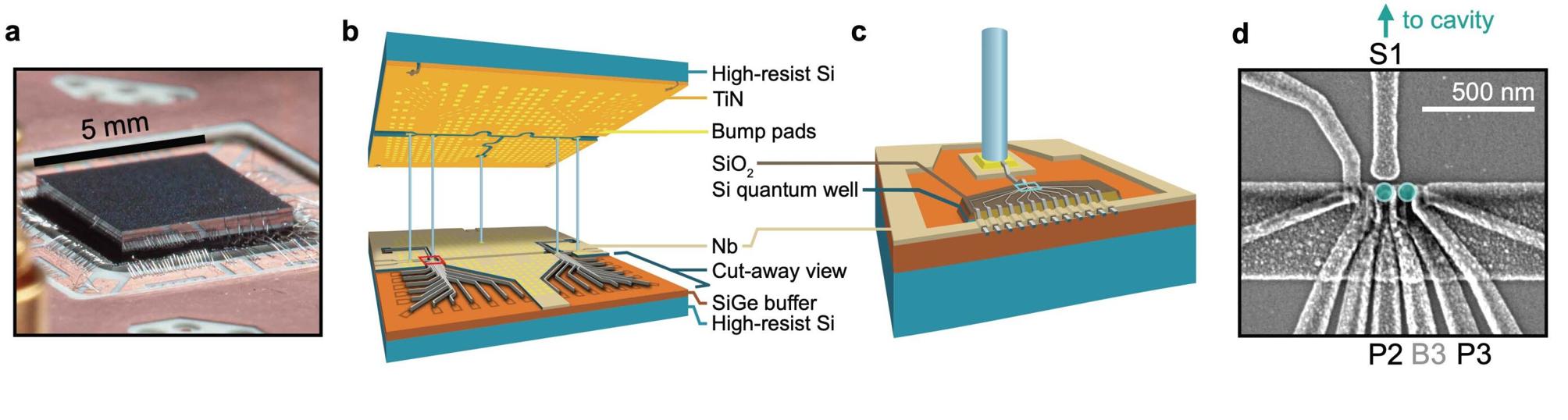
A silicon-based qubit chip coupled to a superconducting resonator chip. Reprinted with permission from J. Corrigan et al., Phys. Rev. Applied, 20 064005 (2023). Copyright (2023) by the American Physical Society.
Remarkably, some of the same materials that power our current, classical electronics can be used to make quantum bits, better known as qubits. The chips in today’s smartphones and computers are made of tiny switches: transistors built from silicon. Those transistors have an electrode that can turn a flow of electric current on and off.
At UW–Madison, students leverage the same cleanroom technology used to make silicon transistors to make silicon qubits. When made in silicon, those qubits have differences: instead of one electrode controlling a current of electrons, they have many electrodes that hold one electron, or sometimes a small handful, in one location.
Qubits are different in other ways, too. Classical bits are binary: they take one of two values, zero or one. Qubits can also take those values of zero or one, yet they can have many values in between. Those in-between values are known as a superposition, and they represent the probability that the qubit, when measured, will be found to be either zero or one.
The promise of quantum computing lies in compounding those possibilities. It is possible to control — to make a change to — a second qubit based on the state of the first qubit. If in so doing the first qubit had to decide its value, this would be little more than what is already present in a classical computer. Instead, qubit number one can remain in a superposition of zero and one, with the action on the second qubit depending on which it is.
How can students take action on a second qubit, depending on the first qubit, without knowing whether the first qubit is a zero or a one? They must make the two qubits interact with each other. In that situation, the students can perform a single action on qubit two, causing a result that will depend on whether the first qubit is a zero or one. Amazingly, that choice can be determined later.
The result, when done properly, is a highly interdependent set of values for the different qubits, known as an entangled state. This ability to generate entanglement between qubits is what enables a quantum computer — all of which so far are much smaller than classical computers — to run prototype algorithms and software.
Much like classical computers, it is likely that quantum computers and technology will have many parts: quantum memory, quantum processing, quantum networking and quantum sensing. Semiconductors like those I study are but one of many technologies that are likely to contribute.
Will the second quantum revolution really come to pass? If we knew for absolute certainty, it would not be research. But it certainly is possible that we — or our children and grandchildren — may look back in another 100 years and say that these were the early days of new ways to gather information, to process what that information means, and to communicate it to one another.
--
About the Author
Mark Eriksson is the chair of UW–Madison’s Department of Physics and the John Bardeen Professor of Physics. He has been working in quantum physics since 2001, tackling the underlying technology that could propel quantum computing. His research interests include quantum computing, qubits in silicon, experimental studies of nanostructures and thermal transport in nanoscale systems.
This content was produced by UW-Madison’s College of Letters & Science. The news and editorial departments of the Wisconsin State Journal had no role in its creation or display. For more information, contact events@madison.com
Uncovering Wisconsin's Black History
As an undergraduate student, I had the opportunity to serve as a National History Day Intern and a National Coca-Cola Museum Fellow at the Minnesota Historical Society. The archive became my favorite place. I was intrigued by the stories that were embedded in old letters, diaries, photos, legislative, business and insurance records, church newsletters, and the myriad of objects that were stored and cataloged. In the margins of the vast collections that focused on the powerful and majority populations, there were fragments of the lives of marginalized peoples. I knew I wanted to tell their stories.
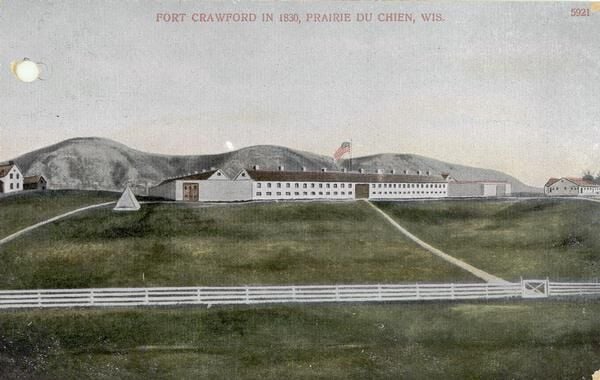
Enslaved African American people were held at forts by military officers throughout the Northwest Territories. During the territorial period (1836-1848), there were at least 17 men, women and children held in bondage at Fort Crawford.
Wisconsin Historical Society
My research focuses on the experiences of Black northerners and Midwesterners on farms, and in small towns and cities in British and French North America in the 17th, 18th and 19th centuries. Slaveholding in the Northeast was legislated and regulated while slaveholding in the Midwest was sparse, irregular and relied on community consent. The social, political and economic reach of the institution of slavery in the Northeast was the focus of my first book — Dark Work: The Business of Slavery in Rhode Island. Contestations over race and citizenship in the Midwest are the focus of my current book — Black on the Midwestern Frontier: Contested Freedom in Wisconsin, 1787—1868. The 1787 constitutional ban on slaveholding in the Northwest Territories was regularly violated and by 1820, there were more than 1,000 people held in bondage in the territories and free Black men were barred or restricted from voting in all Northwest Territories states. Race and rights have always been contested in the Midwest, and current racial disparities are rooted in these often-unacknowledged histories.
Caroline Sheppard was a resident of Pleasant Ridge, which was a Free Black Settlement in Grant County.
Grant County Historical Society, 1863
My current research was inspired by students. When I began teaching in the Fall of 2010, I told my students that history was personal and inherently political. Relying heavily on historian Gerda Lerner, I told them that history matters because it is an essential part of what makes us human. History explains our place in the world and the histories we know and claim shape our understanding of those around us. Students noted that I had no specific material on Wisconsin, and I sought to address that omission.
A series of short historical essays about Black Wisconsinites written by reference librarians at the Wisconsin Historical Society became the foundation of a series of lectures that I incorporated into my Introduction to African American History course. They also inspired the questions that became my current research project: What were the experiences of Black people in the early Midwest and how did they shape the region? More specifically, how did the limited practice of race-based slavery, the migration and settlement of free Black people and debates over abolition and Black rights shape race relations in the Midwest? Investigating these questions is exhilarating but tedious and time-consuming, because the archives were built to collect the records of the colonists — the Europeans who claimed North America and carved out the geographic regions we now take for granted. Although archival evidence about Black Midwesterners before the American Civil War is often frustratingly brief and fragmentary, their stories are essential to understanding the creation and formation of the American Midwest.
Benjamin A. Hughes and 12 other African American men in Racine County petitioned the Wisconsin Territorial Legislature for the right to vote. “Remonstrance against the laws that prohibit suffrage based on skin color.”
Wisconsin Historical Society, 1845
Recovering the histories of men, women and children who resisted their bondage and strove to build lives within the strictures of race-based slavery and state-sponsored racial discrimination is as difficult as it is rewarding. Some days in the archive yield nothing but brief references to the lives of Black Americans who were forced to labor, other days I rediscover a young woman’s successful freedom suit or a riveting petition written by free Black men who were demanding a place in the territorial government. Telling the stories of free Black Americans like New York-born Titus Sutphen and the Virginia-born Shepard brothers who traveled hundreds of miles and became significant landowners is beautifully complicated — they were in search of liberty, but they were also part of the American colonization project that dispossessed native land. Illuminating the stories of Black Wisconsinites like Ezekiel Gillespie who demanded full citizenship and the right to vote reminds us that antiblackness and Black political assertion are part of Midwestern history.
Ezekeil Gillespie successfully sued for the right to vote in Wisconsin in 1865. In 1866, the state Supreme Court overturned the ban restricting the vote to “free white men.”
Wisconsin Historical Society
Black people came to the Midwest by force, coercion, false promises or in search of freedom and liberty. Their presence in this place was part of the disruption and displacement of Indigenous people. These stories are essential to understanding the economic, social and political development of the state of Wisconsin and the Midwest at large. The function of history is not pride or shame, it is a serious and measured inquiry into the spaces and places we call home. History allows us to understand why our world looks the way it does. Historical research is a mirror and lesson about the human condition — our triumphs, shortcomings, and most importantly, our capacity to change and empathize.
--
About the Author
Christy Clark-Pujara is the chair and a professor in the Department of African American Studies. She is also an affiliate in the Department of History. Clark-Pujara earned a B.A. from the University of St. Thomas and a Ph.D. in American History from the University of Iowa.
This content was produced by UW-Madison’s College of Letters & Science. The news and editorial departments of the Wisconsin State Journal had no role in its creation or display. For more information, contact events@madison.com
Igniting innovation
Nestled in the College of Letters & Science is a powerhouse of innovation and discovery that’s making waves in our state and beyond. The School of Computer, Data & Information Sciences (CDIS) at the University of Wisconsin–Madison may have been officially founded in 2019, but its roots run deeper, stretching back over a century.
At the core of the CDIS mission is the Information School, which is a treasure trove of knowledge that has been around since 1906. Think of it as a guardian of humanity’s collective wisdom, from the ancient scrolls of Alexandria to today’s digital archives buzzing through the internet. This story isn’t just about books and databases, it’s also the data and knowledge underlying some of the most innovative discoveries we see today.
The construction site of the future School of Computer, Data & Information Sciences (CDIS) building on UW–Madison’s campus.
Althea Dotzour / UW–Madison
In this digital age, libraries have transformed. They’re no longer just buildings filled with books — they’re vast digital landscapes you can explore from anywhere in the world. This access has revolutionized how we discover and learn, making it possible to dive into centuries of human thought with just a few clicks. It’s like having a time machine at your fingertips, allowing us to make leaps in science, history, technology and more.
And while CDIS is rooted in the past, the true mission is to shape the future. Think of the evolution of libraries from ancient scrolls to digital archives as a metaphor for the CDIS journey. We’re not just witnessing history, we are making it.
CDIS is also home to the second oldest computer sciences department in the country. The first woman to earn a Ph.D. in computer sciences graduated here. The statistics department was founded in 1960 by the famed statistician George Box, well known for his statement that “all models are wrong, but some are useful.” CDIS stands tall among the nation’s elite, with all departments highly ranked while making significant real-world impact. From artificial intelligence to cybersecurity, CDIS is on the front lines of the digital frontier.
But what does this mean for students? It means getting their hands dirty with actual projects that matter because our students don’t just learn — they do.
Take WISCERS, for instance, a program that kicks open the door to the world of computing and data science. Students dive headfirst into research areas in computer sciences, statistics and data science. Thanks to partnerships with industry giants like Google, students gain real-world exposure and mentorship, setting the stage for future success.
The CDIS Capstone Project takes this a step further by pairing teams of students with companies to solve genuine business challenges. Imagine working with giants like Capital One or Epic Systems to build something that could change the game. From research to prototype development, students are immersed in the process, honing their skills and making meaningful contributions.
Then there’s the Creative Destruction Lab, where entrepreneurial dreams meet the rigor of real-world business. Here, students help shape the next big startups, offering fresh ideas and getting invaluable experience in return.
CDIS isn’t just about preparing students for the workforce, it’s about preparing them to lead it by solving the big problems of today and tomorrow. Whether it’s making artificial intelligence more accessible, protecting data from hackers, designing user-friendly tech or unraveling the mysteries of big data, CDIS is at the forefront.
Guests at the University’s 175th anniversary gala signed a beam that will hang in the future School of Computer, Data & Information Sciences (CDIS) building.
Althea Dotzour / UW–Madison
By fostering strong connections with industry partners, CDIS ensures that its curriculum remains relevant and forward-thinking. This enriches learning experiences and fuels Wisconsin’s economy and technological prowess. By bridging the gap between academia and industry, CDIS ensures its students are ready for the future and actively shaping it.
As we stand on the brink of new discoveries and technological advancements, CDIS embodies the spirit of innovation that makes Wisconsin proud. It’s more than a school — it’s a beacon of progress, accessibility and opportunity, lighting up the path for future generations to follow.
As we continue to push the boundaries of what’s possible, the continued growth and support of programs like those at CDIS are crucial. By investing in programs that empower students to think critically, innovate boldly and collaborate effectively, we are shaping the future of technology, business and the state of Wisconsin.
--
About the Author
Tom Erickson is the founding director of the School of Computer, Data & Information Sciences (CDIS) and the executive associate dean of strategy and innovation for CDIS. In addition to serving on UW–Madison's late Chancellor Emerita Rebecca Blank’s advisory council, Erickson co-chaired a working group on the future of computing at the university in 2018. He co-authored the group’s report “Wisconsin in the Information Age.” This led to the formation of CDIS in 2019.
This content was produced by UW-Madison’s College of Letters & Science. The news and editorial departments of the Wisconsin State Journal had no role in its creation or display. For more information, contact events@madison.com
The expanding Yiddish bookshelf
Yiddish author Miriam Karpilove entertains a group of relatives and close friends.
It’s an exciting time to be a professor of Yiddish literature. My bookshelf keeps expanding!
This often comes as a surprise to my students. Yiddish is the historic language of central and east European Jewry and its diasporic communities. For many today, it is seen as a language of the past or as a collection of funny words. But these impressions need revising.
Yiddish continues to be the spoken language of large Haredi communities. In fact, the number of Yiddish speakers is growing, not declining. Today, knowledge of Yiddish drives groundbreaking research on the lives and legacies of Jewish communities around the world. Plus, Yiddish poetry, novels, plays and autobiographies continue to delight.
New readers are finding their way to Yiddish literature — albeit through English. There has, in fact, long been an active American audience for Yiddish literature in translation. By the 1960s, volumes of Yiddish poetry, prose and Holocaust testimony were available in English. But until relatively recently, the texts chosen for translation were primarily written by men.
The past 10 years has witnessed a sea change. And the new wave of translations shares one thing in common: these are books authored by women.
Consider the following names: Miriam Karpilove. Kadya Molodowsky. Debora Vogel. Fradl Shtok.
These are writers who were once known almost exclusively to readers of Yiddish. What’s more, their work was frequently dismissed by male critics simply because they had been written by women. Now, these talented authors are not only attracting the attention of scholars but of a new generation of readers. And their work offers us a deeper understanding of Jewish life and Jewish culture in the 20th century as well as insightful perspectives on contemporary problems.
Karpilove, for example, examines issues of consent in the dating lives of single women in the city. Molodowsky narrates the traumatic effects of migration on a young refugee in America. And Vogel’s poetry asks how the constant presence of advertisements in our lives directs how we see — or don’t see — the world around us.
Everyday sexism. Forced displacement. The frenzy of modern media. These are just a few of the themes of Yiddish writing by women.
My current research explores the short fiction of Shtok (1890-1990). Born in what is today Ukraine, Shtok immigrated to the United States in her late teens. She went on to publish short stories primarily set in the small market town, or shtetl, of her youth.
For someone familiar with Fiddler on the Roof (perhaps the best-known version of a Yiddish original), Shtok’s shtetl is unrecognizable. In Shtok’s world, the concerns of rabbis, milkmen and butchers take a back seat. Instead, the strivings of young women take the lead, as they long for control over their bodies, minds and futures.
Students now experience Yiddish literature as a tradition that includes Shtok, as well as Karpilove, Molodowsky, Vogel and so many others. Our syllabi can now center women’s voices.
And this lets us all read canonical texts anew. Consider here, again, Fiddler on the Roof. The musical adapts a Yiddish text by the popular writer Sholem Aleichem. It follows three daughters from the same family as each selects a spouse on their own rather than agree to an arranged marriage.
On the American stage and screen, the audience focuses on the heroic actions of Tevye, the father, and his ultimate decision to bless the marriages of each of his daughters. There is no doubt that Tevye is the star of the show.
But what happens when you shift the attention from Tevye’s blessings to his daughters’ choices? Who emerge as the decision makers?
For my students studying Yiddish literature, women are now recognizable not only as supporting characters but as creative forces. They have long been writing in the pages of Yiddish literature. Now, they are ready to speak out in English. The bookshelf stands ready.
--
About the Author
Sunny S. Yudkoff is an associate professor of Yiddish studies in the Department of German, Nordic, and Slavic+ and the Mosse/Weinstein Center for Jewish Studies. She is the author of Tubercular Capital: Illness and the Conditions of Modern Jewish Writing (Stanford University Press, 2019).
This content was produced by UW-Madison’s College of Letters & Science. The news and editorial departments of the Wisconsin State Journal had no role in its creation or display. For more information, contact events@madison.com
Music and the human spirit
In this age of rapidly developing artificial intelligence and vast technological acceleration, I often wonder about those distinct features that make us human — those activities and thoughts that distinguish us from not only other living beings, but also from machines. As a composer and pianist, one of my primary goals through my work is to create music designed to engage each of us in this important consideration of our collective humanity.
The UW Concert Choir performs in the Mead Witter Foundation Concert Hall inside the Hamel Music Center.
Brian Huynh / UW-Madison
Why is it so important for us to engage in such contemplation? In many ways, it’s one of the most important questions we can reflect upon. Otherwise, we might as well turn over our future to deterministic computing algorithms. It’s no different than looking up at the sky on a moonless night, far away from city lights, perhaps up in the north woods of Wisconsin. Pondering a vast universe and marveling at our miniscule place in the Milky Way has always given me a sense of reverence and gratitude for our seemingly impossible existence. For me, like many people, this wonder at the cosmos is akin to nothing short of a spiritual or religious experience. I find that the best musical moments are no different — they provide me with a knowledge and clear understanding of our shared humanity that I can’t access anywhere else. This pursuit of pure human spirit is the driver of my life’s work, of my passion to bring similar experiences to people around the world.
The nature of understanding how humans know something comprises a branch of philosophy called epistemology, or the study of knowledge. Perhaps the most familiar type of knowledge is a set of facts that we can justify through rational argument, such as a statement like, “The capital of Wisconsin is Madison because historical records show that the legislature passed a law to make it so in 1836.”
There are other types of knowledge, however, such as knowing how to do something, or knowing an individual. My work as a musician, like that of many other artists, revolves around producing aesthetic knowledge, the type of knowledge one gains from a powerful aesthetic experience. This knowledge is individual and intricate, and very human. It can emerge from many directions — an intense hip hop concert by your favorite artist, an underground poetry reading, an immersive film or a work on a brick wall by Banksy. This understanding exists at a more abstract level from factual comprehension, something not needing the constructs of language to cement itself at the core of your being. My work has proven to me that the best musical experiences, whether as a performer or listener, summon a type of knowledge not attainable through other means.
The great American poet Robert Bly taught us about the “poetic leap,” a journey from the known part of the mind to the unknown, and back. Many of the world’s most important poems contain this leap. The leap is a psychological “aha,” a moment in which the reader just gets it. This is the lightning bolt of understanding, of gaining new knowledge through an aesthetic experience. I have argued, drawing from Bly, that the same thing happens in many art forms — the aesthetic leap. It certainly happens in music. Think about those moments in which you had a transcendental experience through music — most adult humans have. For me, those moments happen most often in classical art, music or jazz, but the medium may be different for anyone. These moments aren’t replaceable with words. They are about feeling and understanding, about a leap into greater human insight.
Ultimately, grappling with the question (or questions) of what makes us human helps us understand our place in our communities, in our country, on our planet and in this universe. This is the main driver of my teaching practice and work in higher education. Music is a profession laden with mentorship practices. In the Mead Witter School of Music, one of my joys is to work with my amazing colleagues to facilitate our students’ internalization of the cultural imperative for the consideration of our unique humanness. Rarely a week goes by in which I am not awestruck by a student’s leap into a fuller understanding of the ways music can prompt understanding in all of us. Musicians at their best — whether performing, composing or revealing the wonders of music through scholarly work — give us those moments that illuminate the humanity we all share.
--
About the Author
Dan Cavanagh is the director of the Mead Witter School of Music, Pamela O. Hamel/Music Board of Advisors Chair and a professor of jazz studies and composition. He has been commissioned by a wide range of classical and jazz artists throughout North America and Europe. His music continues to be performed and recorded around the globe.
This content was produced by UW-Madison’s College of Letters & Science. The news and editorial departments of the Wisconsin State Journal had no role in its creation or display. For more information, contact events@madison.com
Preparing students for a dynamic workforce
L&S students network with alumni and employers at a SuccessWorks event.
What is the role of a liberal arts education in an era when technologies like artificial intelligence are rapidly transforming the workforce? For students like sophomore Kitty Wang, a first-generation student from Franklin majoring in information science and English, the answer is straightforward. By following their passions and supplementing their classroom knowledge with hands-on experience, students in the College of Letters & Science are developing the durable, flexible skills that are increasingly sought by employers and essential to building successful long-term careers.
As she leaned into her information science courses, Kitty discovered she loved crafting computer code to solve problems and create user-friendly experiences. But Kitty also has a passion for literature, which is more than just an enjoyable addition to her education. Through the English major, says Kitty, “I’m developing skills like analytical thinking, gathering information efficiently and writing for a multitude of audiences.”
As a first-generation student, Kitty decided it was imperative to get an early start exploring the wide range of career options unlocked by an L&S degree. She started by enrolling in the L&S career course, where she built her resume and learned how to use, articulate and build upon what she was learning in her classes.
Recent, rapid transformations of the job market are topics of lively discussion among my career advising colleagues at SuccessWorks, where students in the College of Letters & Science come to translate the value of their academic degrees into successful careers beyond graduation. We’re hearing from employers that the changes taking place in the economy and job market underscore and amplify the core value of a degree from L&S.
A recent analysis by the professional social media network LinkedIn found that more than half of current LinkedIn members have jobs poised to be “disrupted or augmented” by AI. The study also found 90% of global executives surveyed agreed that “human” skills such as communication, leadership, project management and teamwork are more important than ever. These are exactly the skills being cultivated by students in 65 majors within the College of Letters & Science, which serves the state of Wisconsin as a vital engine for equipping students with the skills they need to thrive in today’s workforce, and the workforce of tomorrow.
Through career advising and programs, SuccessWorks shows L&S students how to build bridges between their majors and careers. Our advisors, alumni mentors and partners in academic departments encourage students to build on their classroom experiences by trying out different career paths and developing the hands-on skills that activate the value of the L&S degree.
Kitty received vital experience through the SuccessWorks job shadow program, where she sat in on meetings and discussions with the CEO of a prominent tech firm based in the Midwest. “The key insight I took away was that technology intersects with so many industries, and ‘tech jobs’ can take on so many different forms,” she says.
Wisconsin-based Epic Systems — a SuccessWorks Employer Partner — is among the top recruiters of L&S graduates. “L&S students in a nutshell are creative, bright and driven,” says recruiter Amanda S. Mui. “While we’re a healthcare IT company, we hire all majors, and we’re continuously impressed by the unique perspectives and diversity of thought L&S students bring to the table.”
This is the sort of dynamic, people-first workplace Kitty Wang knows her L&S degree is preparing her for as she readies for a career in user experience design. “An L&S degree opens the door to cultivating meaningful experiences,” she says. “Skills such as creativity and analyzing complex problems are developed and valued by my professors and also in the careers I’m exploring.”
--
About the Author
Angie White is the executive director for SuccessWorks at UW–Madison’s College of Letters & Science. White holds a master’s degree in education from the University of Minnesota and has more than 25 years of experience as a career services leader, most of which includes serving L&S students.
This content was produced by UW-Madison’s College of Letters & Science. The news and editorial departments of the Wisconsin State Journal had no role in its creation or display. For more information, contact events@madison.com
The remarkable adaptability of plants
You know the inconspicuous houseplant in your kitchen window? It has superpowers. It, and nearly all plants, harness the energy in the sun’s golden beams to convert carbon dioxide from the air into usable sugars that power their cellular processes. Essentially, plants use sunlight to eat air.
I still remember sitting in class as an undergraduate and learning about this process. I had heard of photosynthesis before, but never had I really thought about the transformation of inorganic carbon dioxide into sugars as something so completely profound. Each fall I try to convey the importance of this process in my Introductory Biology course. We don’t cover the gory details of the biochemistry — I leave that joy for more advanced classes — but instead focus on the beauty of the cycle of photosynthesis. Nearly all the oxygen in our atmosphere, which we require to survive, is a biproduct of photosynthesis.
Undergraduate researcher Ava Copple explains her research to Chancellor Jennifer L. Mnookin at the 2023 Research in the Rotunda in the Wisconsin State Capitol.
Plants’ remarkable features don’t stop at photosynthesis, and the research team I lead in UW–Madison’s botany department aims to uncover more by answering a fundamental question: How do organisms that cannot move across a landscape tolerate the various insults the world hurls at them? Animals, in contrast, move into the sun when they are chilly, or the shade if they are hot, or quickly away if they feel threatened. Plants have none of these solutions as options. Instead, their complex physiology responds to each of these threats in often quite subtle ways. The solutions that plants employ differ among species, varying with the climate in which those species evolved.
Our changing climate has made understanding how plants work even more imperative. Globally, photosynthesis removes an enormous amount of carbon dioxide from the atmosphere each year, ebbing the increase of greenhouse gasses in our air from our use of fossil fuels. Much of the work in our research group is focused on understanding how photosynthesis is limited by the stresses in plants’ habitats, for example drought and high or low temperatures. Part of this involves quantifying how much plants can shift their body plan and function in response to stresses.
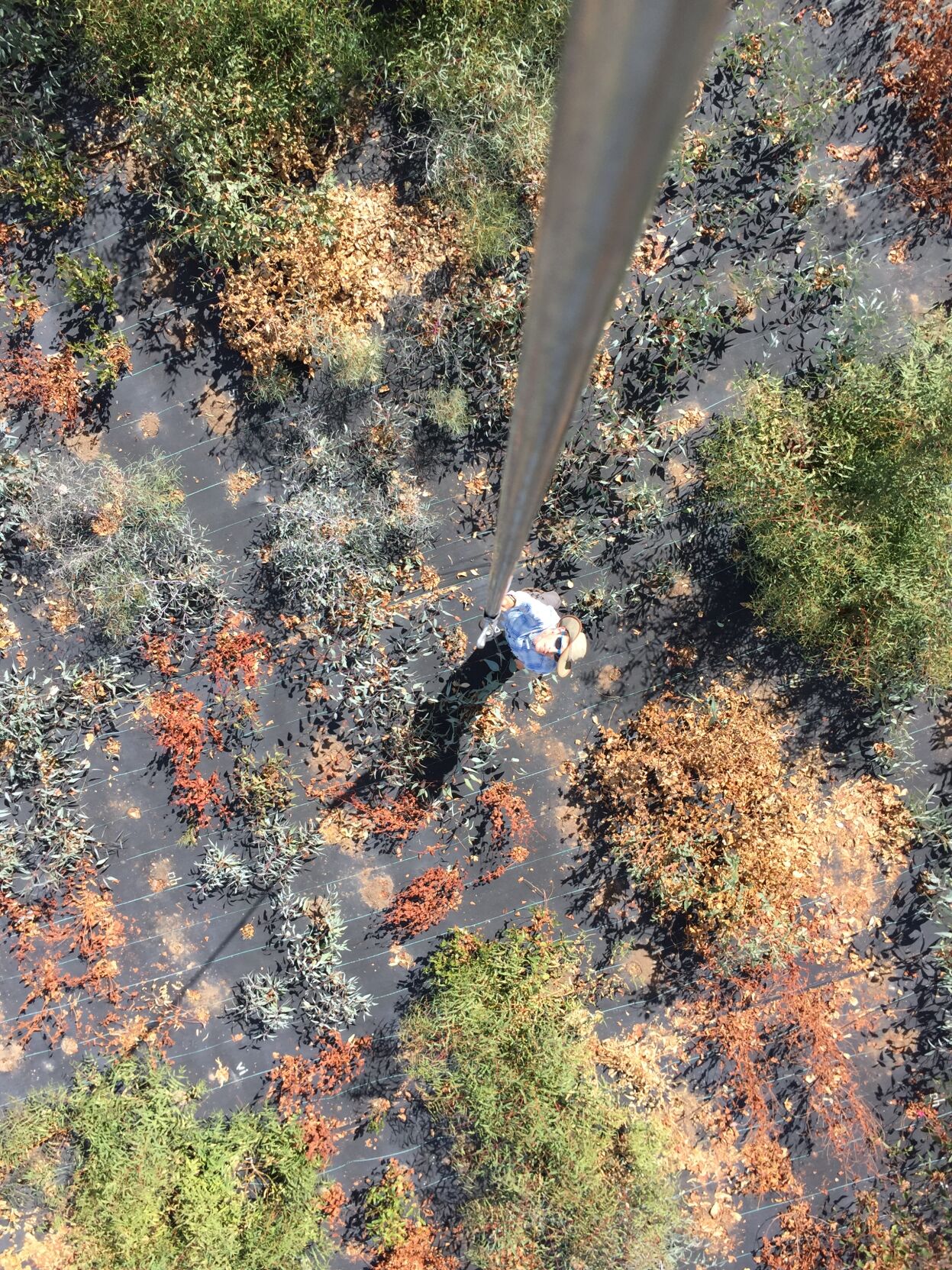
Scientist Duncan Smith uses a very long “selfie stick” to capture the condition of young eucalyptus trees growing in one of the common gardens in Australia.
One recent collaboration with UW–Madison colleagues Tom Givnish – the Henry Allan Gleason Professor of Botany and Environmental Studies – and Scientist Duncan Smith explored these ideas in 10 species of eucalyptus trees that naturally grow in areas that differ in the amount of rainfall they receive annually. Our study species ranged from trees that reach 100 meters tall growing in the moist mountains northwest of Melbourne, Australia to stunted trees that top out at five meters and survive the harsh aridity of Australia’s Outback. We grew individuals from each of these 10 species in each of four sites along this gradient in water availability — from the wet mountain sides in the southwest to the dry interior of Victoria, Australia – and measured various traits ranging from their photosynthetic rates, to how much water stress they experienced, to their sizes. We learned that species can adjust several traits that improve their ability to grow in either wetter or drier conditions than those in which they evolved but are unable to adjust enough to grow as well as in their home conditions.
These results provide useful insight into the limits on species’ ability to adjust to the new conditions created by our changing climate. As part of this project, we also offered a course in which we took 14 UW–Madison undergraduate and graduate students on a 16-day trip to Victoria, Australia, where the students learned about the ecology and evolution of Australian plants and animals and conducted independent research projects that they had developed during our preparative seminar.
Our lab group has worked on several other projects to understand how plants respond to their environment. We have studied how cycads (an ancient group of seed plants who outlived the dinosaurs) evolved to tolerate drought stress, the traits that allow Wisconsin’s trees and shrubs to live in their habitats, how species differ in their ability to take up water through their leaves, what limits the growth of some of the world’s tallest trees, and how species that have evolved with regular fires both survive fires but also facilitate fires. Our lab group prides ourselves on involving undergraduates in meaningful research experiences, and we have worked with students who have gone on to graduate school, industry and government agencies, but also medical, dental and law school. Learning about the remarkable adaptations of plants specifically, but also how to ask scientific questions generally, is enriching, rewarding, and fun!
--
About the Author
Kate McCulloh is an associate professor in UW–Madison’s Department of Botany and the inaugural Rebecca Blank Professor. Her research explores how plants tolerate environmental stresses such as drought. She has studied plants in many habitats, including temperate forests, temperate and tropical rainforests, grasslands and savannas.
This content was produced by UW-Madison’s College of Letters & Science. The news and editorial departments of the Wisconsin State Journal had no role in its creation or display. For more information, contact events@madison.com
Research is the foundation of our liberal arts education
The fundamental strength of UW–Madison’s College of Letters & Science experience is that it is broad and inherently interdisciplinary — characteristics that serve us well in an ever-changing global community. Through the arts and humanities, social sciences, biological and physical sciences, and the computer, data and informational sciences, our liberal arts education prepares students to understand and appreciate a range of disciplines, to think critically and to communicate well. We ensure that our students understand not just what we know about the world, but how that knowledge is built. We call this the act of “sifting and winnowing,” a principal that is the core of our teaching philosophy and a skill that is invaluable for our graduates well beyond their time at UW.
Dean Eric M. Wilcots welcomes the newest class of College of Letters & Science students to campus at the convocation event.
Isabelle Delfosse
One major way that we put these words into action is by prioritizing research as part of the L&S experience. UW–Madison is one of the top-rated research institutions in the world, which means the campus is positively humming with discovery. And much of the groundbreaking findings from the university are coming from researchers in the College of Letters & Science. With experts in fields ranging from computer science and physics to journalism and history, we are at the forefront of research that answers some of the toughest questions facing our society today.
I cannot overstate the importance of curiosity-driven research. My L&S colleagues are driven by questions of how and why. We seek to understand the natural world we inhabit, be it the complex functions of Earth’s atmosphere and climate, freshwater ecosystems or the universe as a whole. We are driven to understand how we as humans interact with one another as individuals and as societies, and how these interactions have changed over the course of human history. L&S research is also inspired by thinking about our political systems, our histories and our cultures and the sometimes difficult truths this thinking reveals. As technology — including the recent surge of AI — has changed our world, we see a need to understand how this changes life for workers, families and everyday citizens.
This edition of “Fueling Discovery” is a celebration of the research that is the lifeblood of the College of Letters & Science. It is our mission to address and tackle the most challenging and important questions of our time. We see this supplement of the Wisconsin State Journal as an opportunity to share our work with our fellow Wisconsinites. In the spirit of the Wisconsin Idea, the research we do in L&S directly benefits the citizens of our state, country and world. In these pages you’ll read essays from faculty members who are at the forefront of their fields and making cutting-edge discoveries covering topics including the ways quantum computing is revolutionizing modern-day technology, how plants are adapting to our changing climates and the formerly untold history of how Black people shaped the early Midwest.
You’ll also hear from our students, who have unparalleled access and opportunities to contribute to the discoveries being uncovered through research on our campus. Being able to work with faculty mentors as an undergraduate studying astronomy shaped my own career, and I’m proud that our students share that same experience today. Through programs like Undergraduate Research Scholars (URS), Letters and Science Excellence in Research (LASER) and L&S STEM Scholars, our undergraduate students are in the field and at the lab working side-by-side with faculty and graduate students. Take Ahmia Williams-Walsh for example. She’s a part of a team in the Department of Chemistry’s Hermans Research Group that is tackling one of the world’s most pressing challenges: How can we produce plastic in a way that lessens the environmental impact? The work being done by her and the research team could have the long-term industry impact of decreasing carbon emissions. And she’s just one of three outstanding undergraduate students featured in this publication, who represent a small sampling of the talent on the UW–Madison campus.
Through the breadth of L&S we are drawn to the realization that research, innovation and creativity are the engines that drive discovery. By fueling discovery today, we are investing in our future and that of our children and the world they will inherit.
--
Paulius Musteikis
About the Dean
Eric M. Wilcots is the dean of the College of Letters & Science and the Mary C. Jacoby Professor of Astronomy in the Department of Astronomy, his home department since 1995. Dean Wilcots is committed to creating an environment where all can succeed and thrive. In 2020, he launched the Dean’s Initiative for Diversity, Equity and Inclusion and created the STEM Scholars program, which provides critical support for L&S students entering the university with an interest in science, technology, engineering or math. He is currently presiding over the design and construction of a new L&S academic building, Irving and Dorothy Levy Hall, as well as a new facility for the School of Computer, Data & Information Sciences, Morgridge Hall. Dean Wilcots is dedicated to promoting outreach and the Wisconsin Idea and serves as co-chair of the Wisconsin Science Festival.
This content was produced by UW-Madison’s College of Letters & Science. The news and editorial departments of the Wisconsin State Journal had no role in its creation or display. For more information, contact events@madison.com