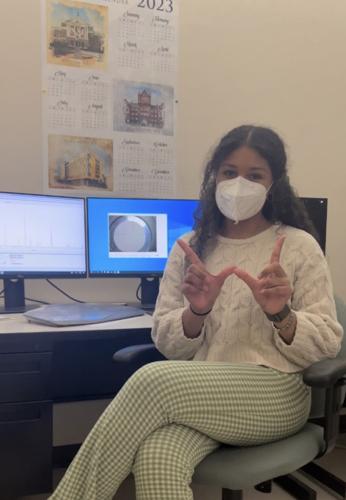


Ahmia Williams-Walsh in the lab doing data analysis of the XRD machine spectra X-ray refraction machine.
As soon as Ahmia Williams-Walsh came to campus from Menasha, she hit the ground running looking for research opportunities. Now, as a junior majoring in chemistry, biochemistry and sociology, she’s involved in a significant sustainability effort by the Department of Chemistry’s Hermans Research Group to find practical ways to decrease the amount of carbon emissions it takes to produce plastics
Why did you choose UW–Madison?
You really can’t beat the research programs here. One of the things that was important for me was to feel confident I would find good undergraduate research opportunities. I was able to find that here beginning my freshman year.
What’s your research about?
We focus on the polypropylene reactions, the synthesis of plastics and polymers in industry, which creates a lot of carbon and pollutes the environment. The way that we are trying to negate that is by creating a catalyst that would lower the amount of energy needed and lessen the pollutants.
People are also reading…
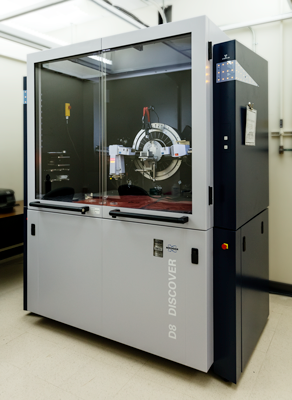
X-ray diffraction machine
What does it take to create a catalyst with this kind of capability?
We do it in a really fun way — it’s called impregnation — it means that we have an alumina base or an element base and we add other elements to it and then mix it up until it looks good. And then we put that in the oven to heat up and get the water off it, because if there’s water, it won’t react as well. After that, we do a few tests on the synthesized catalyst. This is where I step in. I do some X-ray diffraction, which is an analytical technique where you put the catalyst in this really big machine and it shoots X-rays at it, and the angles that it diffracts at will tell you how the catalyst is loaded. I specifically look for any migration of elements — changes or things that we don’t want to see. I’m looking to make sure that everything looks normal. After that, I go and do other analytical techniques to test and make sure that the catalysts can hold up in the reactor. And then after that, I assist in running the reactor, and we put it under conditions that industry would use and make sure that it will create what we want to create and that it is lowering the energy threshold and that it isn’t giving off as much or more CO2 than what industry would do.
What’s the goal for this research project?
We’re testing really stable catalysts to see what elements we can add to lessen the impact on the environment in the production of plastic products.

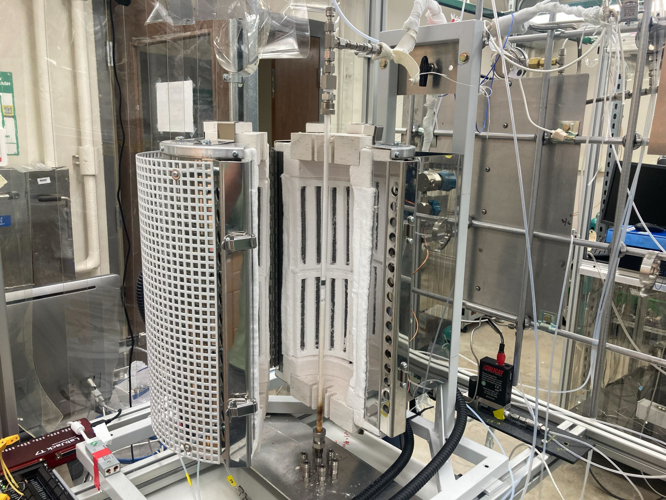
The reactor used to test the synthesized catalyst at high temperatures and designed chemical environments.
If this research is fully realized, what would the impact be?
Industry cares about one thing, and that’s the bottom line. We recognize that in order to help the environment we need to work with that, otherwise we can’t make big changes. By implementing a catalyst into industry and lessening the amount of energy that’s needed for these really big reactions, not only are we going to be able to push less energy into the reaction — and that’s in and of itself more sustainable — but there’s less CO2 emissions.
How has being able to do research on campus affected your college experience?
I don’t think I’ve ever done something that’s helped me gain as much confidence as research. Being able to go into the lab, put on my lab coat and my goggles, be there, do actual science and have it work out has to be one of the most amazing feelings I’ve ever felt in my entire life.
--
About the Researcher
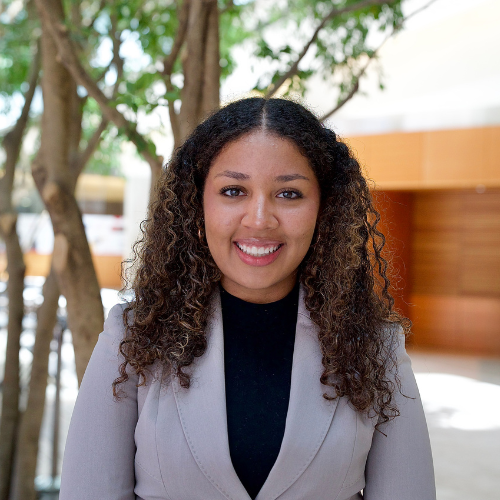
Ahmia Williams-Walsh is a third-year chemistry, biochemistry and sociology major hoping to continue her education in medicine after receiving her degree. She is an undergraduate researcher in the Hermans Research Group focusing on heterogeneous catalysis and sustainability. Outside of schoolwork and research, she is also an L&S Dean’s Ambassador, peer mentor, medical program assistant for Mendota Mental Health Institute and a Mercile J. Lee scholar.