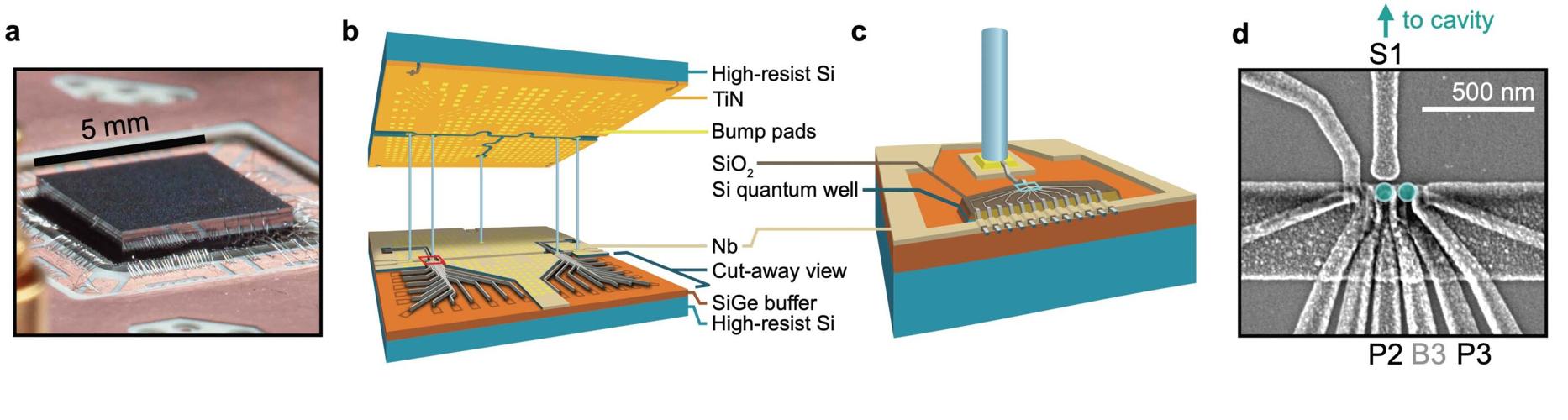

In laboratories at UW–Madison, students regularly trap single electrons inside silicon chips. They know where the electrons are. They know when they move. And they can monitor that motion in real time on a computer screen. To me, those sentences are truly remarkable.
The motivation of those students is even more exciting: to build technology that will help fulfill the promise of the second quantum revolution.
The first quantum revolution is now a legendary tale in science and technology. About 100 years ago scientists figured out the rules — collectively known as quantum mechanics — that govern the motion and behavior of atoms and electrons. Building on that initial understanding, society has transformed itself through inventions quantum mechanics enabled: integrated circuits, lasers, all of our mobile phones and computers.
Those advances collectively are now known as the first quantum revolution. The first, because it now seems possible that a second quantum revolution is on the horizon.
People are also reading…
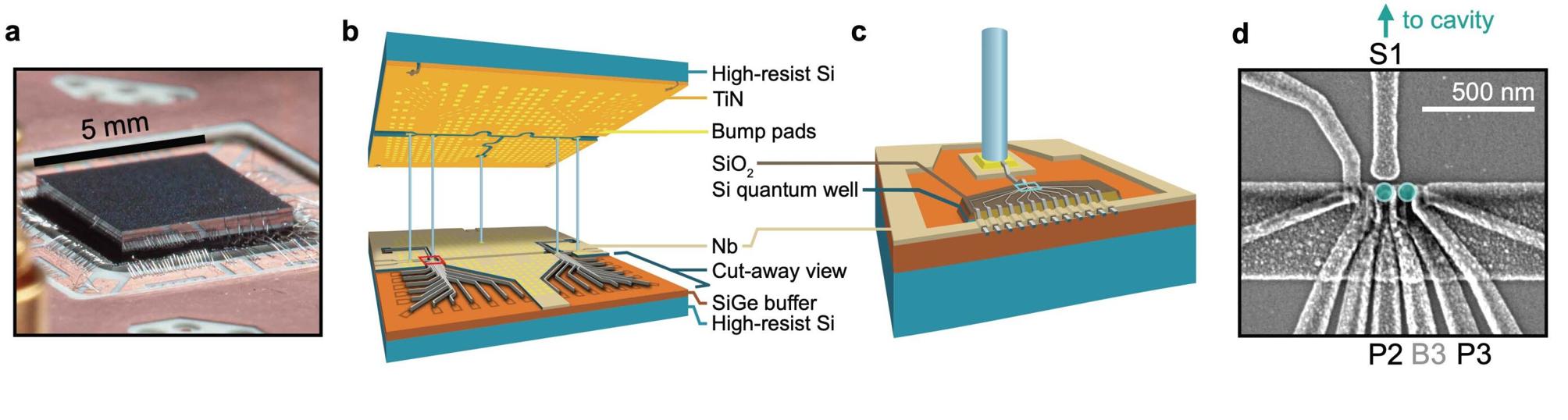
A silicon-based qubit chip coupled to a superconducting resonator chip. Reprinted with permission from J. Corrigan et al., Phys. Rev. Applied, 20 064005 (2023). Copyright (2023) by the American Physical Society.
Remarkably, some of the same materials that power our current, classical electronics can be used to make quantum bits, better known as qubits. The chips in today’s smartphones and computers are made of tiny switches: transistors built from silicon. Those transistors have an electrode that can turn a flow of electric current on and off.
At UW–Madison, students leverage the same cleanroom technology used to make silicon transistors to make silicon qubits. When made in silicon, those qubits have differences: instead of one electrode controlling a current of electrons, they have many electrodes that hold one electron, or sometimes a small handful, in one location.
Qubits are different in other ways, too. Classical bits are binary: they take one of two values, zero or one. Qubits can also take those values of zero or one, yet they can have many values in between. Those in-between values are known as a superposition, and they represent the probability that the qubit, when measured, will be found to be either zero or one.
The promise of quantum computing lies in compounding those possibilities. It is possible to control — to make a change to — a second qubit based on the state of the first qubit. If in so doing the first qubit had to decide its value, this would be little more than what is already present in a classical computer. Instead, qubit number one can remain in a superposition of zero and one, with the action on the second qubit depending on which it is.
How can students take action on a second qubit, depending on the first qubit, without knowing whether the first qubit is a zero or a one? They must make the two qubits interact with each other. In that situation, the students can perform a single action on qubit two, causing a result that will depend on whether the first qubit is a zero or one. Amazingly, that choice can be determined later.
The result, when done properly, is a highly interdependent set of values for the different qubits, known as an entangled state. This ability to generate entanglement between qubits is what enables a quantum computer — all of which so far are much smaller than classical computers — to run prototype algorithms and software.
Much like classical computers, it is likely that quantum computers and technology will have many parts: quantum memory, quantum processing, quantum networking and quantum sensing. Semiconductors like those I study are but one of many technologies that are likely to contribute.
Will the second quantum revolution really come to pass? If we knew for absolute certainty, it would not be research. But it certainly is possible that we — or our children and grandchildren — may look back in another 100 years and say that these were the early days of new ways to gather information, to process what that information means, and to communicate it to one another.
--
About the Author
Mark Eriksson is the chair of UW–Madison’s Department of Physics and the John Bardeen Professor of Physics. He has been working in quantum physics since 2001, tackling the underlying technology that could propel quantum computing. His research interests include quantum computing, qubits in silicon, experimental studies of nanostructures and thermal transport in nanoscale systems.