


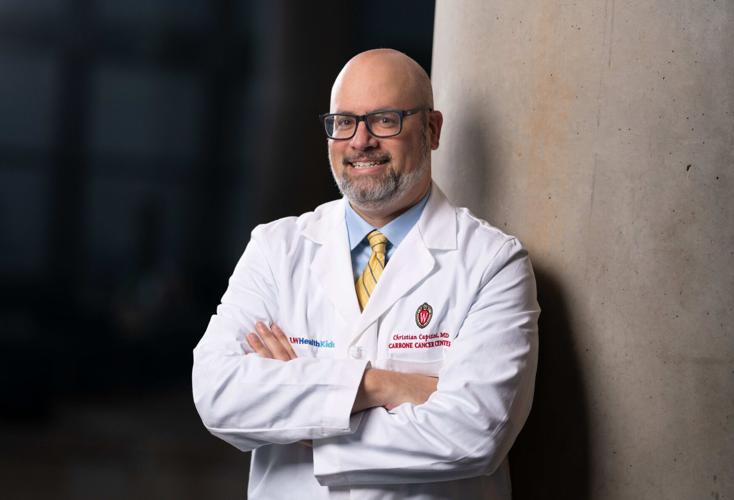
That focus on patients as a guiding light will continue as Capitini becomes UW Carbone’s newest director, leading one of the first National Cancer Institute-designated comprehensive cancer centers in the U.S. with a bold vision of accelerating research discoveries to enhance clinical care. He takes pride in being able to serve a new role with the campus, health system and community he has loved since he first arrived in Madison 15 years ago.
“It’s a tremendous honor to be able to now serve in this capacity, and I want to keep setting the high bar my predecessors had set and try to make the cancer center better for the next generation of researchers and clinicians,” said Capitini, a professor of pediatrics at the UW School of Medicine and Public Health.
People are also reading…
Capitini became the cancer center director in April, more than a year after being selected as the center’s acting director when Dr. Howard Bailey retired in December 2024. This interim experience has been invaluable for Capitini to get a broader view of the impact the cancer center has on campus, with UW Health and in communities across Wisconsin.
Capitini touted the strength and breadth of immunotherapy research happening on campus. Immunotherapies empower the body’s own immune system to recognize and fight cancer cells. In Capitini’s lab, they develop cellular immunotherapies like chimeric antigen receptor (CAR) T-cells, or white blood cells that are collected from a patient, engineered to better recognize and attack cancer cells, and infused back into the patient.
“I think we’re in a unique spot with cellular immunotherapies where we can actually create some of these from scratch based on the unique expertise within the cancer center and on campus in general, and leverage the infrastructure on campus and at UW Health to develop these therapies, so I’m excited to explore how we can grow that infrastructure and recruit more talent through RISE-THRIVE,” he said.
Capitini also is impressed with UW’s investment in theranostics research, an innovative approach where radioactive molecules are used to both map tumors in a patient’s body and deliver precision treatment directly to those tumors.
“The idea that we can also make clinical-grade isotopes with our investment in cyclotrons and leverage the expertise on campus in radiochemistry, medical physics, radiology, imaging and radiation oncology to be able to deliver not just FDA-approved medicines but again, create homegrown drugs that have the potential to help us better diagnose and treat cancer is really exciting,” he said.
While serving as director means Capitini will not have time to keep his normal clinic schedule, he will provide on-call inpatient coverage at American Family Children’s Hospital to stay connected to patient care.
“It’s really important for me to still have some inpatient responsibilities as director, because that’s ultimately why I became a physician — to care for children with cancer and help them navigate that journey,” he said. “But aside from personal fulfillment, I also think it makes you a more effective leader to be on the ground floor caring for patients, opening clinical trials and bringing questions back to research labs for new solutions. You’re seeing in real time some of the issues patients face and barriers that come up in research.”
During his time as acting director, he has also been building connections among other cancer center leaders to discuss ways to tackle shared challenges, such as availability of cancer research funding.
“Funding concerns are not unique to our cancer center, and that’s the value of being in this role and having the fellowship of other cancer centers — so that we can have a seat at the table and navigate it together,” he said.


