


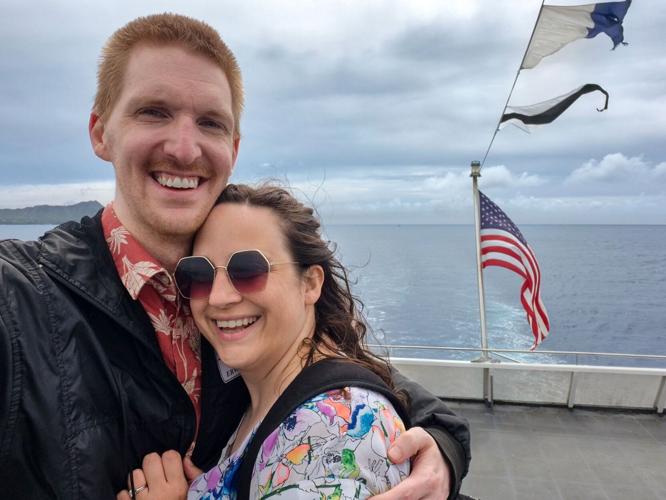
In 2021, Michael Wilson went to his primary care physician to remove a mole that had been on his back for many years. What he expected to be a routine cosmetic procedure led to a shocking stage 3 melanoma diagnosis at age 33.
“I had this mole on my back my whole life, and suddenly I was deep into this new world of terminologies that I had to go learn,” said Wilson. “That was quite worrying, and I didn't really know what to make of it. You know, I never went into this thinking that this was going to be cancer or anything.”
Five years after starting treatments through the UW Health | Carbone Cancer Center, Wilson currently has no evidence of melanoma. Along with standard imaging scans to monitor for new tumor growth, Wilson also is part of a clinical study testing the use of a blood test to screen for circulating tumor DNA. The goal is to detect evidence of cancer in the blood at an earlier stage, before it can form into tumors in the body.
People are also reading…
“And it’s been helpful for me to know the status of his cancer at each encounter,” said Dr. Vincent Ma, Wilson’s medical oncologist. “His melanoma circulating tumor DNA is undetectable, so it gives me an additional layer of confidence that he continues to remain in remission.”
Following his 2021 diagnosis, Wilson had another surgery to remove more tissue around that mole and where the cancer had spread to in nearby lymph nodes. He then participated in a clinical trial treatment with immunotherapy, a drug that helps the body’s immune system target and fight cancer cells, to prevent melanoma from returning.
Wilson received another shock when, in July 2023, Ma discovered a new melanoma spot on Wilson’s left arm that did not share a genetic link to his existing melanoma. That meant it was a new, concurrent diagnosis to treat. Following surgery to remove that new spot, he learned his initial melanoma had spread to additional lymph nodes in his armpit.
Despite the setbacks, Wilson focused on a perspective that helped him move forward.
“Even though it seems like things are just getting worse and worse and worse, things are actually getting better because you're learning about it and taking action,” he said. “I'm discovering the problem and then we're addressing the problem, because the only alternative is inaction.”
After a third surgery in 2024, Wilson received additional immunotherapy, radiation therapy, and a targeted therapy designed to affect specific mutations in the cancer, which he completed in November 2025. Since then, his scans have shown no evidence of cancer.
Wilson works as a software engineer for Sun Nuclear, a company that develops software enhancing patient quality assurance for cancer clinics around the world. As a patient at Carbone, Wilson was able to see how the software he helped create was used in his own radiation treatment plan.
“It was really surreal in a way, because it's like, oh, this is me. This is not patient 123, what I'm used to seeing (when working on the software),” he said.
For Wilson, his experience reinforced the importance of a comprehensive cancer care team. Apart from support from his family and friends, he also credits the support services at Gilda’s Club Wisconsin for having a huge impact on his attitude and positive outlook.


