
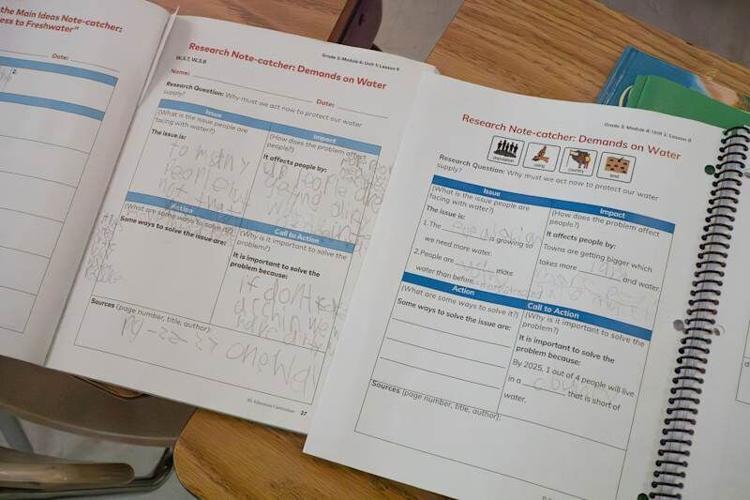
If you took a close look at the textbooks in Ms. Blevins' third grade class at Marquette Elementary, you might notice they do not all look exactly the same.
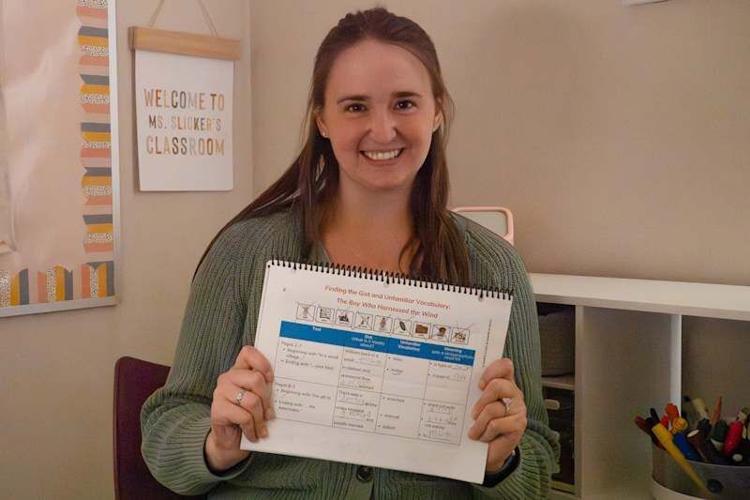
That is because Madeline Slicker, a cross-categorical teacher, has gone the extra mile to make learning materials accessible to students at any stage in their learning.
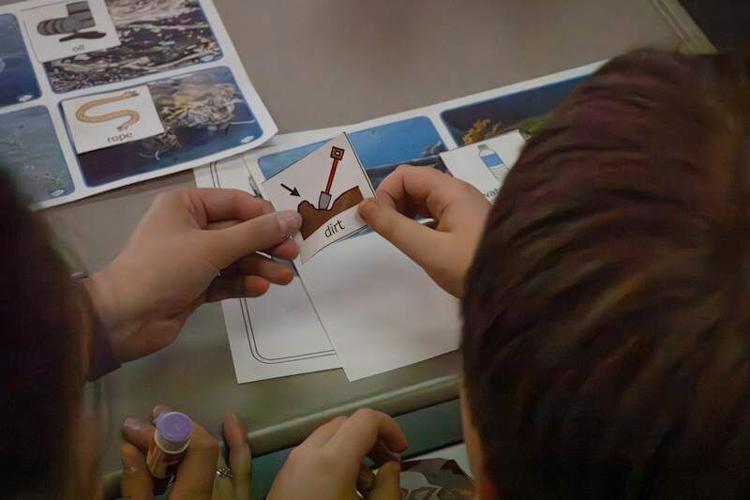
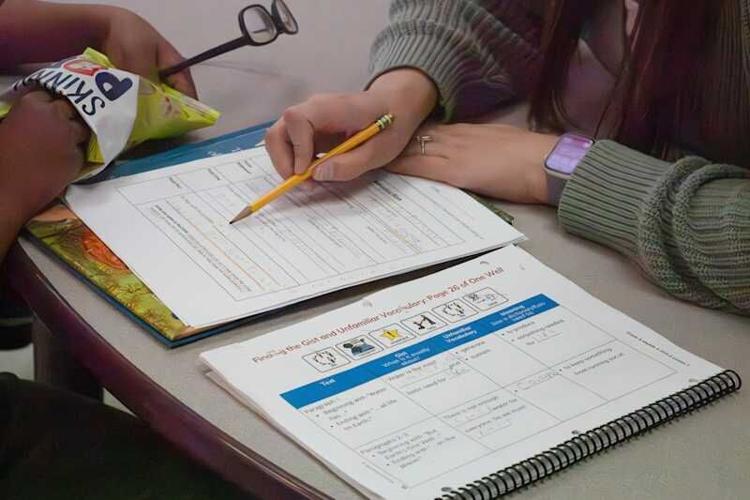
What might be an intimidating blank space in the original textbook gets replaced with built-in academic supports. Rather than instructions to write about environmental challenges on an empty page, Slicker’s textbook guides students with key words and sentence stems they have to finish.
“It’s little things that keep students going, so helping them feel successful rather than overwhelmed can really keep them engaged in school,” Slicker said. “By intentionally planning these supports between general education and special ed teachers, we’re able to make classroom instruction cohesive so everyone gets to learn in the same room.”
People are also reading…
This seamless inclusion is the result of a massive, hidden undertaking that begins long before the students ever open up a binder.
When Marquette received new learning material after MMSD’s switch to align the literacy curriculum with the Science of Reading, Blevins and Slicker realized the textbooks asked a lot of students who might not be reading at their grade level.
“As part of their learning, students are expected to write their proof paragraph, which allows them to demonstrate what they have been learning in each unit,” Blevins said. “However, we know that all students learn differently, and for some, writing that paragraph was really tough. Seeing that, I wanted to make sure they weren’t getting left behind.”
So before she opens up her design software, Slicker sits down with grade level teachers to dissect the upcoming curriculum and brainstorm how to make grade-level standards reachable for everyone ahead of every quarter.
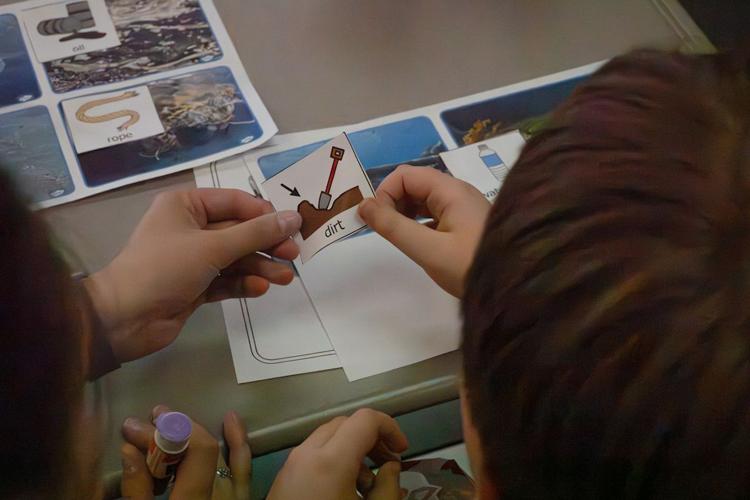
With that knowledge she then adds supporting material into their textbooks, carefully crafting sentence stems and picture-coded key words into each page.
“We also make sure the accessible textbook really closely mirrors the materials their peers are using,” Slicker said. “We want it to feel like a seamless part of our instruction, rather than something separate.”
Making the textbooks a part of routine classroom instruction was a big deal — by the time students reach third grade, small-group collaboration becomes a key piece of their instruction.
By providing accessible textbooks, all students can learn together.
“Some of our students who are still learning to read will sit with their group mates, and their group mates will help them understand our key words,” Slicker said. “It’s just such a collaborative process, and it’s really exciting to see that.”
Allowing students to work side by side means ensuring that everyone is working toward the same goal, even if some require a few extra steps to get there.
While the accessible textbooks help create a pathway to the answer, the actual material remains just as rigorous as the standard edition textbook.
“We intentionally designed these to align with the same standards and learning goals any other student has,” Slicker said. “We’re adjusting the access, but not the expectations.”
The result has been nothing short of spectacular.
Over the past three years Slicker said students have been performing better on end of unit assessments and performance tasks.
That growth shows up in daily victories, like a student who previously struggled to write now confidently spelling out complex vocabulary words without a visual aid.
“Every student can and will succeed when given the right tools and support,” Marquette principal Becky Peterson said. “The accessible textbooks Ms. Slicker creates are exactly the tools some of our students need to reduce barriers and access their grade-level curriculum.”
With third graders' knowledge on the rise inside Marquette, Slicker's passion project is getting attention from other MMSD schools at other grade levels.
Because curriculum at different grade levels requires vastly different support from one another, over the summer she will be sharing her blueprint and collaborating with teachers from across the district to see how her process can be tweaked to fit each and every school.
“I’m really proud of everything I’ve done,” Slicker said. “The textbooks are ever-evolving and can always be improved, but it’s exciting to see that hard work pay off as student outcomes improve, which is the most important part.”