

A major cyberattack has just shut down water and power in several cities and disrupted communications throughout Wisconsin. Cell phone networks are down, first responders can’t communicate, farmers can’t use GPS in the fields, the gas pumps aren’t working and the ATM you just visited flashes an error message.
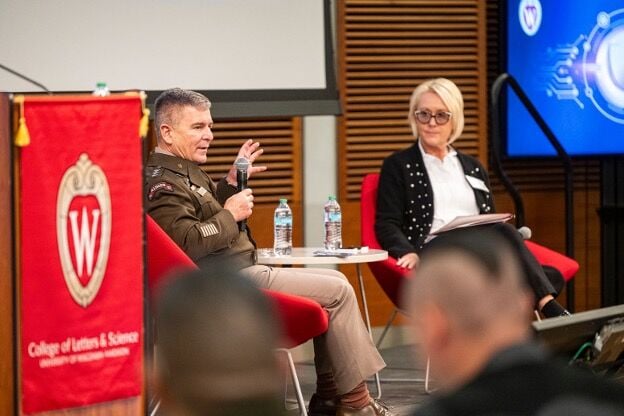
Lt. Gen. William J. Hartman discusses the critical role academic institutions like UW–Madison play in advancing cyber capabilities, developing new technologies and preparing a capable workforce.
This scenario may sound frightening, but it’s exactly what faculty, students and researchers in the College of Letters & Science are working to prevent. From designing secure software, to hosting real-world cybersecurity exercises, to securing quantum computing and artificial intelligence, our people are at the forefront of cybersecurity research and education.
UW–Madison has been a leader in computer science research and education for decades. We awarded the first U.S. PhD in Computer Science to Sister Mary Kenneth Keller in 1965. Today, with the creation of the School of Computer, Data & Information Sciences (CDIS), we are bringing multiple disciplines together under one roof — literally — with the opening of our new home in Morgridge Hall located in the heart of campus in the fall 2025 semester.
People are also reading…
Now, we are taking that leadership to the next level, by creating new partnerships with industry and government throughout Wisconsin and the country. These partnerships enable us to reach more people with our expertise and capabilities and create an even greater impact for Wisconsin. From the theoretical to the practical, we are creating foundations to secure the systems and software that are behind the services we rely on every day.
Researchers in the Security and Privacy Research Group (MadS&P) study issues in all kinds of computing systems, including machine learning, the internet, cyber-physical systems and the human element. These projects take both the attacker’s and defender’s perspectives. Our faculty participate in national conversations to create solutions to secure critical infrastructure such as utilities, transportation, elections and emergency services.
Our efforts are being recognized nationally. Last year, the National Security Agency (NSA) designated UW–Madison as a National Center of Academic Excellence in Cyber Research (CAE-R). This prestigious designation recognizes UW–Madison as a key resource to assist the government in solving the most challenging cybersecurity problems confronting our nation. UW–Madison is also a founding member of the academic engagement network for U.S. Cyber Command (USCYBERCOM).
While at UW–Madison, students taking a software security course participate in cybersecurity exercises like Cyber Badger, which partners with the Wisconsin National Guard’s cyber teams, the Cybersecurity & Infrastructure Security Agency (CISA), Federal Bureau of Investigation (FBI) and other federal, state, local and industry partners. Students also take part in hackathons and cybersecurity clubs which take their cybersecurity education beyond the classroom.
Faculty, staff and students who volunteer on Wisconsin’s Cyber Response Team (CRT), run by the Wisconsin Department of Emergency Management (DEM), play a key role in incident response in the state, too. We engage partners in the University’s Office of Cybersecurity on cyberattacks, ransomware and other cyber events, and take part in Cyber Lucrezia, a three-day regional exercise that trains civilian and military participants in cyber incident response.
Leaders from USCYBERCOM, the NSA and the Cyber National Mission Force (CNMF), our nation’s premier cyber warfighters, visited campus late last year to learn more about our advanced capabilities. Lt. Gen. William J. Hartman, acting commander of U.S. Cyber Command and acting director for the NSA, spent a day meeting with researchers and educators. "People and partnerships are the most important assets we have,” said Hartman during his keynote address in the Discovery Building on campus. “The talent we are building today in schools like the University of Wisconsin–Madison will shape the future of our cybersecurity workforce."
We’re developing that workforce now. Computer sciences and data sciences are our largest and fastest growing majors, and those graduates will enter the workforce throughout the public and private sectors in Wisconsin and beyond. And the need for this expertise isn’t just at the traditional tech companies like Apple, Google and Amazon — it’s everywhere, from healthcare, to agriculture, to manufacturing, to finance, to our communities across the state. Our graduates contribute their skills all over, from USCYBERCOM to Harley-Davidson.
In our digital world, the stakes of cybersecurity have never been higher. From safeguarding critical infrastructure to training the next generation of cyber defenders, the University of Wisconsin–Madison is not just responding to the challenges of today but shaping the solutions of tomorrow. Our work not only creates new innovations, but it also protects our state from cyber threats that could bring our schools, businesses, factories and hospitals to a halt.
As Lt. Gen. Hartman says, “We win with people.” By fostering innovation, building partnerships and preparing a skilled cyber workforce, our people are ensuring that Wisconsin remains resilient, secure and thriving. It’s the Wisconsin Idea in action, keeping the engines of Wisconsin running strong.
To learn more about UW–Madison’s cyber programs and designations, visit go.wisc.edu/cyber.
—

About the Author
Dave Schroeder is the associate director of intelligence and security initiatives in the College of Letters & Science and research director of the Wisconsin Security Research Consortium. Schroeder also serves as a cyber warfare officer in the Wisconsin Army National Guard and previously served as a cryptologic warfare officer in the Navy.