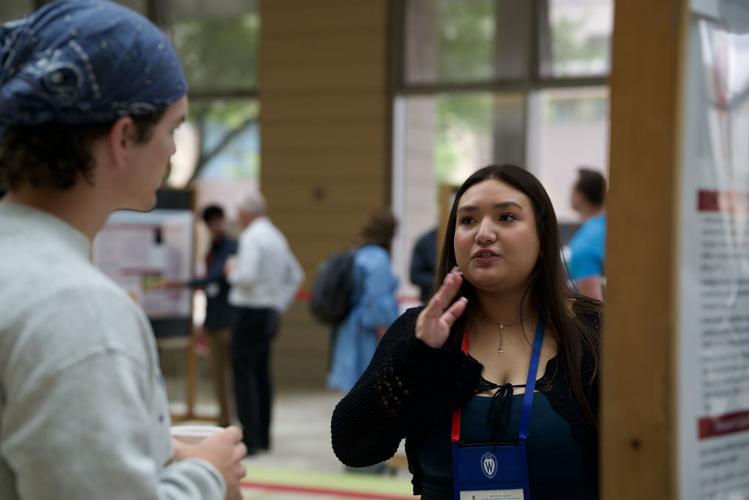


After a summer of conducting research on Alzheimer’s disease, Alexandra Ugalde presents her findings at the LASER Symposium poster presentation.
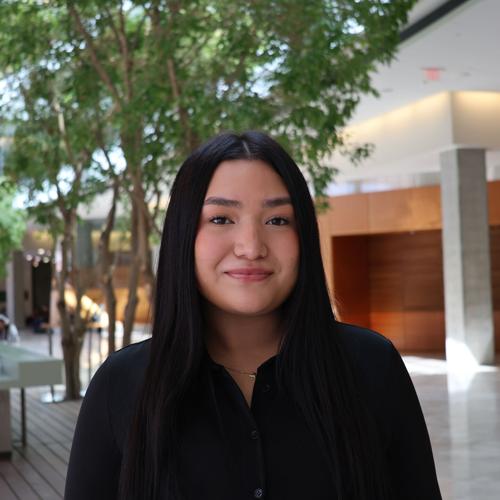
Sophomore Alexandra Ugalde came to UW–Madison with the goal of receiving the education she needs to become a veterinarian. The College of Letters & Science’s zoology major was a natural fit for her, but a summer conducting research on Alzheimer’s disease opened her eyes to an interest in pursuing work in health, too. After a conversation with her Letters & Science Summer of Excellence in Research (LASER) program mentor, she decided to add certificates in global health and political science to her course load.
Why did you choose UW–Madison?
UW–Madison was my dream school since junior year of high school. Most students from my high school go to community colleges or don’t go to college at all, so UW–Madison was kind of a big stretch. I have two older sisters, and we come from a first-generation Mexican immigrant family, so their high school and college experiences are really different from mine. I was the first person in my family to go out of state for college. But it was my dream school because of the veterinary program.
People are also reading…
For the LASER program, you get to participate in a major research project. What was yours about?
My project over the summer was to answer this question: How do cultural values affect Latinos’ intention to seek care for Alzheimer’s disease and related dementias (ADRD)? I worked with the Wisconsin Alumni Research Foundation, the Wisconsin Alzheimer’s Institute, Dr. Maria Mora Pinzon and her team. A little background on Alzheimer disease: It’s an epidemic among the Latino population, and it’s a significant social and cultural issue. Evidence shows that Alzheimer’s disease in Latinos will grow exponentially over the next few decades, from 379,000 in 2021 to 3.5 million by 2060. That’s a very big jump, and Latinos experience a lot of language barriers and stigma that ultimately affect the way they seek care.

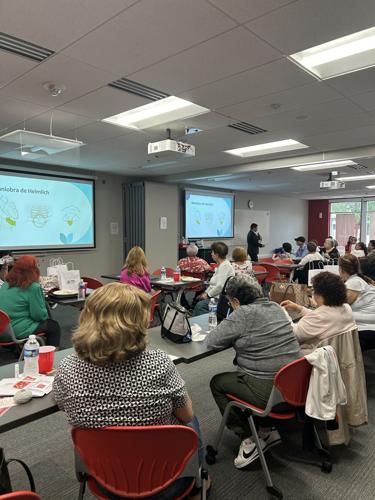
In an effort to support Wisconsinites, Alexandra Ugalde and her fellow researchers hosted a workshop about how Alzheimer’s disease impacts swallowing skills.
What does this research look like in action?
In order to combat this issue, it’s essential to consider tradition, socioeconomic status, education and migration status. We did a cross-sectional study where we sent out surveys in Wisconsin and California to people over the age of 18 and who identify as Latino. It was a five-page survey, and a sample question is: “How effective are the medications that doctors provide for Alzheimer’s disease?” We had 6.3% answer “not at all,” 23% answered “a little” and almost 40% answered “some.” Obviously within this whole cohort of people there are big discrepancies, because we want everybody to answer 100% on “very.” Because we want Latinos to know that they are cared for the same way as other people, races and ethnicities. From this, we concluded that understanding culture values is crucial for developing effective outreach, education and support programs to the Latino community in order to improve ADRD resources and care services that they receive.
What were some of the highlights from doing this research?
We did a bunch of workshops over the summer. One of them was educating people in the Wisconsin community on swallowing and how Alzheimer’s disease affects that skill. The goal was to work directly in the community. We also reached out to home care and mental health services to provide people who have Alzheimer’s, or people with family members who suffer from the disease, to give them resources here in the Wisconsin area.
How has the opportunity to do undergraduate research impacted your college experience?
When I was in high school, I never expected to be at UW–Madison, and even more, I didn’t expect to ever be doing research. LASER introduced research to me as a freshman and made it clear that even though I was a first-year student, I can still do it as much as a fourth-year or third-year student. No matter where you come from, no matter your background, you can be a researcher. LASER helped me navigate this and made it so that I didn’t feel alone.
How would you sum up your time with the LASER program?
It was one of the best experiences I’ve ever had. I loved every minute of staying in Madison over the summer. It was really great to be surrounded by people who want to do the same thing as me and are driven.
—

About the Researcher
Alexandra Ugalde is a sophomore at the University of Wisconsin–Madison majoring in zoology with certificates in global health and political science. As part of the Letters & Science Summer of Excellence in Research program, she spent the summer after her freshman year researching Alzheimer’s disease. She is also a student in the Mercile J. Lee Scholars Program.