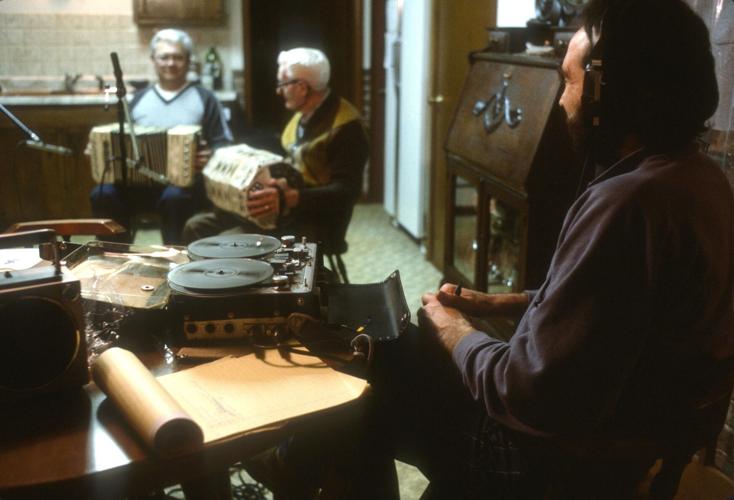


James P. Leary records Irving DeWitz and his son Robert, at the DeWitz home in Dodge County for the German American Music Project.
Every place is in its own way a center of the world, distinct from yet interconnected with every other place. My place has always been Wisconsin.
I was born in Rice Lake, an “up north” farming, logging and market town. Raised in the 1950s and 1960s, I discovered my schoolmates, neighbors and elders hailed from varied backgrounds. Some were Ojibwe, Metís, French Canadian, and Belgian; others English, Irish, Scottish, and Welsh; Austrian, German, and Swiss; Danish, Finnish, Norwegian, and Swedish; Czech, Polish, Lithuanian, Russian Jewish; Italian, Lebanese; African American, and Mexican.
Words and phrases from other languages — boozhoo, machree, ach du lieber, uff da — sprinkled everyday speech. I heard stories about Ole and Lena, Pat and Mike, lumberjacks and farmers in kitchens and on playgrounds. I sampled homemade krumkaker, kielbasa, kraut, and kolacky at church dinners and in friends’ homes. Local radio and festive events sometimes featured Dutchman polka bands, Swiss yodeling and powwow drums, while the World’s Largest Collection of “Odd” Lumberjack Musical Instruments festooned the walls of The Friendly Buckhorn bar and cafe.
People are also reading…
These formative experiences — coupled with my journalist parents’ curiosity and inclination to write about the world around them — never left me. As an undergraduate English major, I luckily realized I was a folklorist-in-the-making. Subsequently earning a PhD in Folklore and American Studies, I also learned that researchers — overwhelmingly privileging the East, the South and the West — largely neglected the rich folk cultures of Wisconsin and the Upper Midwest.
I had found my path, twisty and bumpy though it was. From the mid-1970s through the 1990s — thanks to a series of grants and contracts with non-profits or government agencies — I did field research with culturally diverse rural and working-class crafters, cooks, storytellers and especially musicians throughout the Upper Midwest that contributed to countless exhibits, festivals, films, presentations, public radio programs, publications and record albums.
When UW–Madison’s new Folklore Program beckoned in 1984, I taught part time before becoming a faculty member in 1999, just as the National Endowment for the Humanities sought grant proposals for university-based regionally oriented humanities centers. With L&S support, Professor Joe Salmons and I won funds to launch the Center for the Study of Upper Midwestern Cultures (CSUMC). Now in its 25th year, CSUMC fosters field research, online archival collections and public program partnerships focused on the languages and folklore of our region’s many cultural communities.
Committed to the Wisconsin Idea— what happens at the university should benefit the whole state — we have collaborated regularly with museums, performance venues, public libraries, local historical societies, K-12 educators, ethnic organizations, tribes, labor unions, community groups, researchers, artists and media producers statewide, as well as the Wisconsin Arts Board, the Wisconsin Historical Society, the Wisconsin Humanities council and Wisconsin Public Media. Our mission informs folklore and linguistics courses, and students participate frequently in our public work through field schools, symposia and as project assistants.

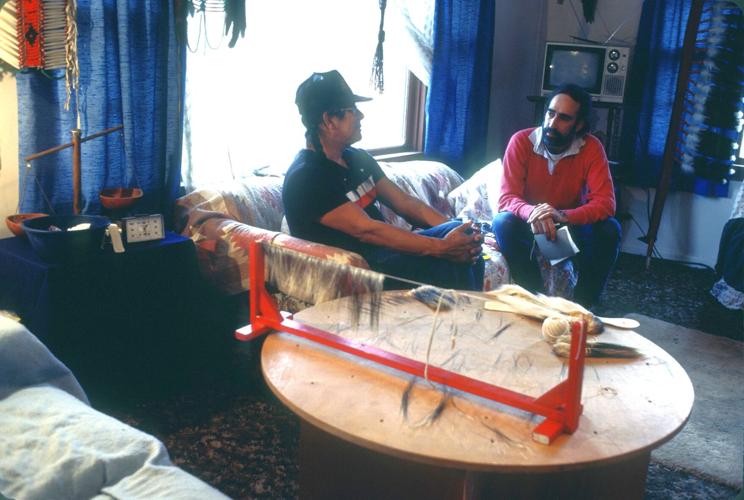
James P. Leary interviews Joseph Ackley at his home in Lac du Flambeau.
A trio of freely accessible websites offer glimpses of our ongoing efforts. Wisconsin Languages (wep.csumc.wisc.edu) explores varieties of English, along with the Indigenous, immigrant and refugee languages spoken in our state. Nordic Folklife (folklife.wisc.edu), ably led by Anna Rue and Marcus Cederström, supports the practice and understanding of Scandinavian American folk arts, including their frequent intersection with the artistic traditions of neighboring Upper Midwesterners. Local Centers Global Sounds (search.library.wisc.edu/digital/ALocalCenters), jointly produced with UW–Madison’s Mills Music Library, is a portal featuring images, manuscripts and sound recordings from ethnic/folk/roots musical traditions flourishing in our region.
Since our concern with local linguistic and cultural matters occurs within global and national contexts, we work regularly with international colleagues and institutions whose diasporas extended to Wisconsin. We likewise advocate for our region within an American mainstream that often ignores or stereotypes the Upper Midwest. In 2024, for example, my three-year effort succeeded when the Library of Congress’s National Recording Registry included the Wisconsin Folksong Collection (search.library.wisc.edu/digital/AWiscFolkSong).
Comprised of roughly 900 field recordings made for the Library of Congress from 1937-1946, mostly by Helene Stratman-Thomas of what is now UW–Madison’s Mead Witter School of Music, the Collection showcased traditional songs and tunes representing occupations (farmers, loggers, railroad workers, Great Lakes sailors) and 25 cultural/linguistic communities throughout Wisconsin. Long ignored because of English-only melting pot approaches to American history, the vibrant, dazzling multilingual performances of ordinary folks from all parts of our state testified indisputably to the cultural diversity that has always made our place special and our nation great.
—

About the Author
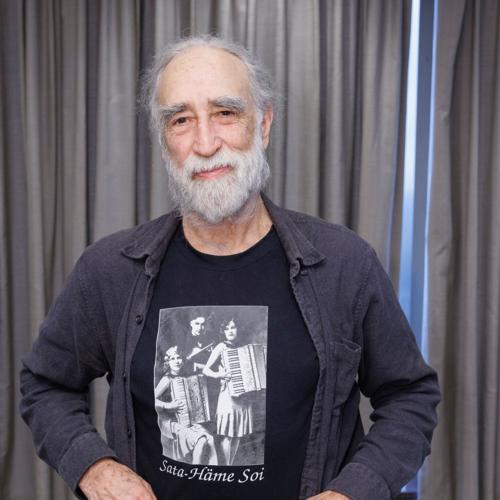
James P. Leary, emeritus professor of folklore and Scandinavian studies, co-founded the Center for the Study of Upper Midwestern Cultures. A two-time Grammy nominee for Album Notes, his books include: Wisconsin Folklore; So Ole Says to Lena: Folk Humor of the Upper Midwest; Polkabilly; and Folksongs of Another America.