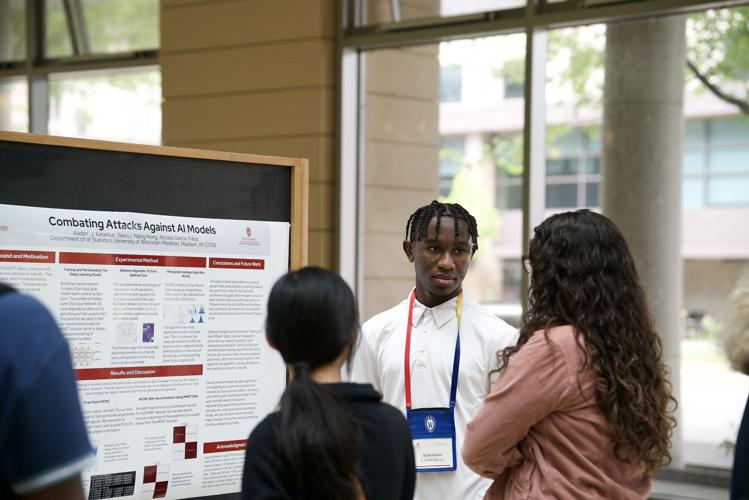


After a summer of researching AI models, AJ Ketarkus presents his findings at the LASER Symposium poster presentation.
How can we prevent artificial intelligence models from getting things wrong? That’s the question on the mind of AJ Ketarkus, a sophomore who worked over the summer with Nicolas Garcia Trillos, an associate professor of statistics. Ketarkus is majoring in computer sciences and electrical engineering and participated in the Letters & Science Summer of Excellence in Research (LASER) program. Until applying for LASER, Ketarkus hadn’t thought about doing research, but now he views it as an essential stepping stone in his undergraduate experience.
Why did you choose UW–Madison?
I was originally born in Ghana but I was adopted at a very young age, and I’ve lived in Madison my whole life. I chose to go to school at UW–Madison because my family has come here for many generations, and they’ve all been very successful. So, obviously, the University is doing something correctly if my parents were able to find success after they graduated. Also, UW–Madison has a great computer sciences program.
People are also reading…
For the LASER program, you get to participate in a major research project. What is yours about?
My project is called “inverse adversarial training through optimal transport.” An example of this work is when a self-driving car stops when it sees a stop sign. But if a person has spray painted over the sign and a letter is covered up, the self-driving algorithm might not interpret it as a stop sign and drive straight through, maybe even causing an accident. So, our research is trying to work backward and figure out what might cause an AI model to correctly or incorrectly interpret something.
Why is research on this important?
If you know what might have caused an AI model to do what it wasn't supposed to, then you can find a way to combat that from happening again. That’s where the idea of the inverse adversarial training comes in. In the stop sign example, the adversarial would be the person covering the sign. Then, through working backward, you get to the point where you know what might have caused the AI model to interpret that wrong. And then you can train the AI model so that the next time, if it sees a letter covered up, it will still know it’s a stop sign because it’s a red hexagon. Then the AI knows it should stop, and not just drive through.
This was your first research experience on campus. What did you learn?
One big thing is that research isn’t easy. In research, there’s going to be a lot of stuff that you don’t know, especially when you’re just starting. But with the help of my professor and fellow researchers — including undergraduate students Jonathan Tong and Emilie Ye and graduate students Sixu Li and Yaling Hong — I was able to get to the point where I understood what I was doing and was able to have a bigger impact on the research.
How has the opportunity to do undergraduate research impacted your college experience?
Even if you don’t continue down the research path, this process helps you develop skills that will benefit your career in other ways. Being given work to do and handling those assignments on your own teaches you what it’s like for people to count on you in a project. That’s an important skill that you develop while doing research.
—

About the Researcher
AJ Ketarkus is a sophomore at the University of Wisconsin–Madison majoring in computer sciences and electrical engineering. As part of the Letters & Science Summer of Excellence in Research program, he spent the summer after his freshman year researching how to combat attacks against AI models. He is also a scholar in the Center for Academic Excellence.