

In recent months, cryptocurrency has surged into the mainstream, with over 500 million users worldwide. This rapid adoption has raised new concerns about protecting digital wallets and the secret “seed phrases” that secure them. As these challenges grow, UX/UI designer Mengzhe Ye is gaining national recognition for making hidden security risks visible — and solvable — through design.
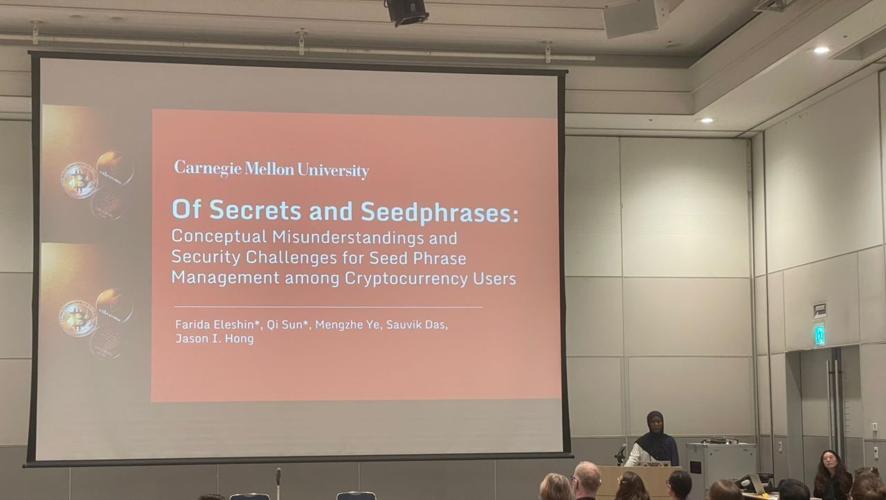
Ye recently co-authored a peer-reviewed study, Of Secrets and Seedphrases: Conceptual Misunderstandings and Security Challenges for Seed Phrase Management among Cryptocurrency Users, presented at CHI 2025. Conducted with colleagues at Carnegie Mellon University, the research has attracted attention in both human-computer interaction (HCI) and fintech. By interviewing cryptocurrency holders and surveying 643 users, the team revealed striking misconceptions. Only 43% of participants could recognize a valid seed phrase when shown one, and many assumed a lost phrase could be reset like a password. Few had plans for passing on their crypto in the event of death — a blind spot with serious consequences for inheritance and long-term security.
People are also reading…
The paper delivers “actionable insights for the design of more secure and user-friendly cryptocurrency wallets.” Ye’s contribution was central in turning findings into design solutions, from wallet interface improvements to built-in education features. “Hidden risks in emerging tech often remain invisible until it’s too late,” Ye explained. “Seeing friends struggle with their wallets made me realize many security pitfalls are really UX problems in disguise—problems design can fix before they cause harm.”

Ye’s commitment to intuitive, user-centered design extends beyond academia. In 2024, she co-led the creation of OpusClip, a generative AI video-editing tool that transforms long videos into short, shareable clips. Its algorithm identifies the most engaging moments, mimicking a human editor’s workflow. “OpusClip aims to democratize video content creation, making it accessible for anyone with a story to share,” one design review noted. With a single click, users can generate social-media-ready highlights — saving hours of manual editing.
The impact was immediate. OpusClip earned a 2024 New York Product Design Award and has since built a community of more than four million users. Ye’s leadership in the project showcased her ability to translate advanced AI into approachable, everyday tools. By focusing on simplicity and user needs, she helped transform a complex system into something creators of all levels could use.
Ye’s journey into design has been unconventional. She trained first as an architect, completing a B.Arch at the University of Liverpool and a Master of Architecture at the University of Virginia. That background nurtured her appreciation for human-centered design and how environments shape behavior. Later, at Carnegie Mellon, she pivoted into human-computer interaction and educational technology. Today, she is a UI/UX designer at the New York-based edtech firm Hats & Ladders, where she creates digital tools to enhance teaching and learning.
This interdisciplinary path fuels Ye’s broader mission: using technology as a force for equity, education, and usability. Whether streamlining classroom software or safeguarding crypto assets, her goal remains the same — to empower everyday people through thoughtful design.