


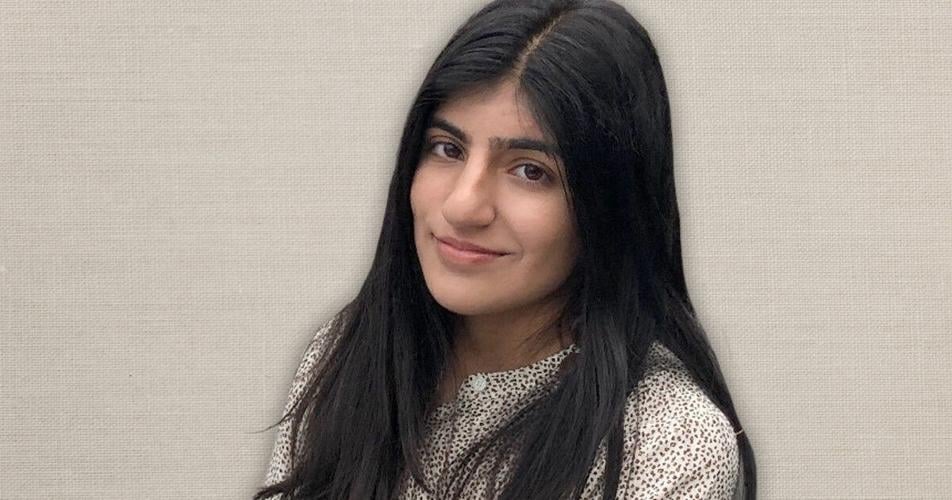
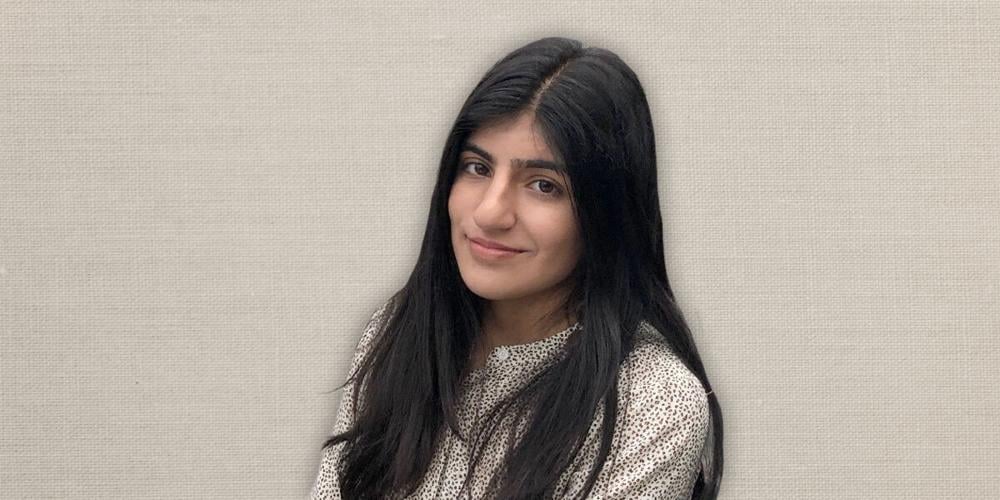
Aryana Wadhwani, a University of Wisconsin–Madison undergraduate, has been awarded a 2026 Udall Scholarship, a highly competitive national honor that identifies future leaders in environmental, Tribal public policy and Native health care fields.
“I was sitting with one of my really, really good friends over at the Discovery Building when I found out,” she shares. “And I just started bawling, literally. It was such a beautiful moment for me.”
Wadhwani will receive up to $7,500 for academic expenses. She also will be eligible to participate in networking, critical-thinking and community-building activities with other Udall Scholars and alumni of the program. She was one of 65 scholars chosen from a nationwide search by the Udall Foundation.
Wadhwani, who is 19 and a rising junior, is majoring in human development and family studies with a certificate in global health. She has been focusing on how exposure to environmental toxins, such as heavy metals, can affect children’s growth and development.
People are also reading…
Wadhwani has spent the past two years as an undergraduate research assistant at the Wisconsin site of the NIH-funded Healthy Brain and Child Development (HBCD) Study, the largest long-term analysis of early brain and child development in the United States. Her review on cadmium- and arsenic-contaminated soil and its neurotoxic effects on children worldwide has been submitted for publication in the Journal of Exposure Science and Environmental Epidemiology.
She is, as she puts it, “infatuated” with the growing but specialized interdisciplinary field of pediatric environmental neurotoxicology. “I feel like making interdisciplinary connections is such an important step as we navigate climate change and the new weather patterns that we’re seeing now.”
Wadhwani, whose parents are from India, recounts a childhood memory that left a great impression on her during a visit there. It was a brutally hot day in Mumbai, near the Gateway of India. While most of the people around her were focused on the landmark, she found herself paying attention to the homeless children walking through the crowded streets in the extreme heat. “Even as a child,” she points out, “it made me think more deeply about how climate, environmental stressors and poverty can shape long-term health outcomes for children.”
Julie Poehlmann, a UW professor of human development and family studies who serves as one of the principal investigators of the HBCD Study, speaks highly of Wadhwani’s dedication to environmental issues. “It is clear in her work, as she has independently sought out additional academic opportunities to learn about and engage in scholarship on neurotoxicity, child development and health outcomes.”
Poehlmann adds, “I have really enjoyed working with her and seeing her continue to grow in her passion and talents.”
What does the future hold for Wadhwani? She wants to expand the work of the nonprofit she started at 15, The World We Once Knew, which focuses on climate health and environmental neurotoxicology education. Through it, Wadhwani hopes to organize and participate in side events surrounding COP31, the United Nations Climate Change Conference that will be held in Antalya, Turkey, in November 2026.
And what about the big picture? “I want to put environmental neurotoxicology at the forefront of international legislative systems,” she says, “to allow the scientific community to play a role in the legal side of decision-making. That is my grand goal.”


